
Subscribe to Our Newsletter
Join our community and stay updated.

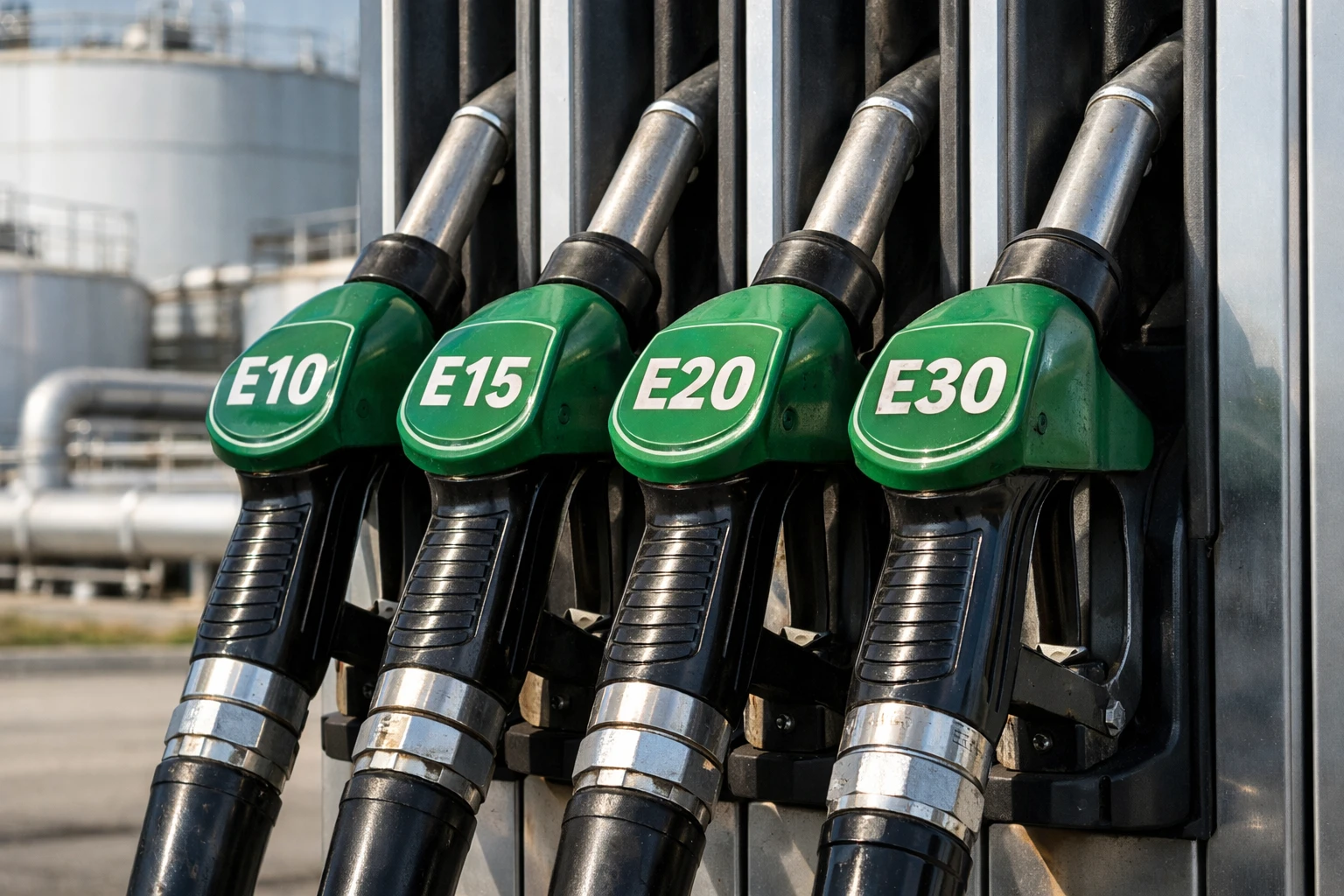
Ethanol blending has moved from being a niche policy experiment to becoming a central part of modern fuel strategy. Around the world, governments are increasing the ethanol blending percentage in petrol to reduce fossil fuel dependence, improve air quality, and strengthen domestic energy security as ethanol contributes to cleaner fuel systems and lowers overall carbon intensity in transport fuels.
But what exactly do E10, E15, E20, and E30 mean? And how do higher ethanol blends affect fuel economics, infrastructure, and long-term sustainability?
This guide explains ethanol blending levels clearly and examines their broader impact on the fuel industry.
Ethanol blending levels indicate the proportion of fuel ethanol mixed with petrol.
The “E” stands for ethanol, and the number refers to the ethanol percentage in petrol.
Ethanol blended petrol is used as a cleaner alternative to conventional fossil fuels. Since ethanol contains oxygen, it enables more complete combustion compared to pure petrol, helping reduce certain tailpipe emissions.
As countries revise their biofuel blending ratio, the shift from E10 to E20 and beyond represents a structural transition in the fuel mix rather than a small technical adjustment.
The push for higher ethanol blending is driven by three main factors: energy security, environmental performance, and rural economic development.
Many countries rely heavily on imported crude oil. Increasing ethanol blending reduces petrol demand, helping lower import bills and improve energy independence. Even a 10–20% substitution has a measurable macroeconomic impact.
Ethanol is a renewable transport fuel derived from agricultural feedstocks such as sugarcane, corn, or agricultural residues. Compared to fossil fuels, ethanol can reduce lifecycle greenhouse gas emissions, especially when produced efficiently.
Ethanol production creates demand for crops and biomass, strengthening rural supply chains. In many economies, biofuel policies are closely linked with farmer income stability and agro-industrial growth.
For these reasons, ethanol blending mandates are no longer short-term programs; they are part of long-term decarbonization strategies.
To understand how these blending levels influence the fuel ecosystem, it is important to examine the technical and operational differences between them.
Increasing the blending ratio changes several technical and economic parameters in the fuel system.
There is a unique "tug-of-war" in the chemistry of ethanol blends:
Higher octane allows engines to operate at higher compression ratios without "knocking." In modern, turbocharged, or high-compression engines, the increased efficiency from the higher octane can partially or sometimes fully offset the loss in energy density.
Higher ethanol blends generally reduce:
Moving beyond E10 requires adjustments in:
Ethanol is hygroscopic (it absorbs water), which means fuel infrastructure compatibility becomes critical at higher blending levels.
At E20 and E30, compatibility of seals, gaskets, and pipelines must be evaluated carefully. While manageable, this requires planning and investment.
The economics of ethanol blending operate at multiple levels: production, blending, and national fuel expenditure.
The cost of ethanol depends on:
In regions with strong agricultural output, ethanol can be competitively priced relative to petrol.
Raising blending from E10 to E20 significantly increases feedstock demand. This stimulates:
Advanced biofuel pathways, especially waste-based ethanol, improve sustainability while reducing food-versus-fuel concerns.
Fuel retailers and refiners must adapt blending infrastructure. While initial capital investment is required, long-term benefits include:
In many cases, ethanol blending becomes economically attractive when supported by stable policy frameworks.
One of the central arguments for higher ethanol blends is carbon footprint reduction.
The true environmental impact of ethanol must be assessed on a lifecycle basis from cultivation and processing to final combustion.
At E20 or E30, the cumulative reduction in fossil carbon intensity becomes meaningful at a national scale.
Ethanol blended petrol can also reduce certain harmful exhaust components, contributing to improved urban air quality.
However, policy and monitoring remain important to ensure optimal combustion performance and avoid unintended trade-offs.
Scaling from E10 to E20 or E30 is not only a policy decision, but it also requires logistical readiness.
Because ethanol absorbs moisture:
Blending terminals need precise control systems to maintain consistent ethanol blending percentage.
Retail fuel outlets may require:
Infrastructure adaptation is gradual but essential for long-term stability.
Globally, E10 has been the standard entry-level blend for many years. Now, several countries are positioning E20 as the next baseline.
The transition toward E20 represents:
E30 and higher blends are typically linked with flex-fuel vehicle systems, but from an industry perspective, E20 appears to be the practical balance between environmental gains and infrastructure feasibility.
Ethanol blending is not a standalone solution. It works alongside:
However, unlike emerging technologies, ethanol blending can be implemented quickly within existing fuel systems, making it one of the most scalable sustainable fuel alternatives available today.
As energy systems evolve, the role of ethanol will likely expand through:
E10, E15, E20, and E30 are more than just fuel labels. As blending levels move from E10 toward E20 and higher, ethanol is transitioning from a supplementary additive to a core component of the fuel mix. This shift reflects broader changes in energy security priorities, emissions reduction strategies, and agricultural economics.
For renewable fuel producers and industry participants such as Edhas Biofuel, higher ethanol blends signal a structural realignment of supply chains, infrastructure planning, and long-term investment. Understanding this progression is essential for navigating the next phase of global energy markets.
E10, E15, E20, and E30 refer to the percentage of ethanol blended with petrol. For example, E10 contains 10% ethanol and 90% petrol, while E30 contains 30% ethanol and 70% petrol.
Governments are increasing ethanol blending to reduce crude oil imports, lower carbon emissions, improve fuel octane ratings, and strengthen domestic energy security.
Yes. Ethanol has lower energy density than petrol, so higher blends like E20 or E30 may slightly reduce mileage compared to E10. However, they can improve combustion efficiency due to higher octane content.
As ethanol blending rises, storage tanks, pipelines, seals, and fuel system components must be compatible with higher alcohol content to prevent corrosion and material degradation.
It depends on policy goals. Higher blends like E20 and E30 reduce fossil fuel dependence and emissions but require compatible engines and supply infrastructure. E10 remains easier to implement in existing systems.

Get the latest updates on renewable energy, sustainability trends, and our initiatives delivered straight to your inbox.