
Subscribe to Our Newsletter
Join our community and stay updated.

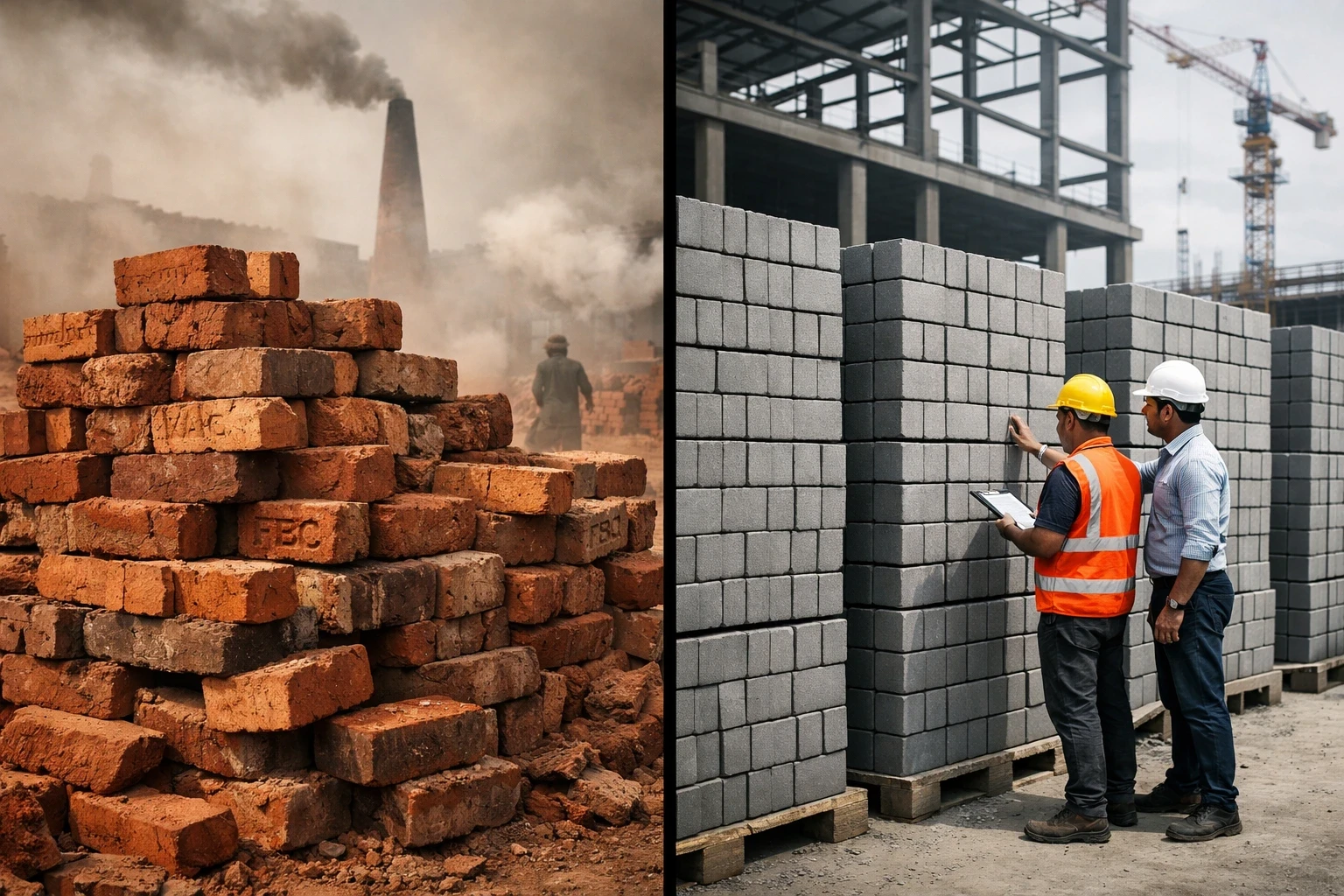
India lays billions of bricks every year. From housing colonies in Gujarat to commercial towers in Mumbai, bricks remain the backbone of Indian construction. But not all bricks are equal and the choice you make affects your building's strength, your costs, and the environment around you.
For decades, red clay bricks dominated the market. Today, fly ash bricks are rapidly gaining ground backed by government mandates, green building norms, and clear performance advantages.
So which one should you choose?
For most modern construction projects, fly ash bricks are the smarter choice.
Red clay bricks are made from the top layer of fertile soil that is excavated, moulded into shape, and then fired at high temperatures in traditional kilns. They have been used in Indian construction for centuries and remain widely available across most regions.
However, their production comes at a cost:
Fly ash bricks are made from fly ash, the fine powder left over from burning coal in thermal power plants combined with cement, lime, sand, and water. The mixture is machine-pressed into shape under high pressure and then cured, not fired.
This process:
At Edhas Biofuel, fly ash bricks are part of a zero-waste manufacturing approach, where industrial by-products of our ethanol production process are converted into high-quality construction materials.
Parameter |
Fly Ash Bricks |
Red Clay Bricks |
| Compressive Strength | 90–100 kg/cm² |
35–70 kg/cm² |
| Weight |
Lighter |
Heavier |
| Water Absorption |
Low (6–12%) |
High (15–20%) |
| Thermal Insulation |
Better |
Moderate |
| Eco-Friendliness |
Uses industrial waste |
Destroys fertile topsoil |
| Upfront Cost |
Slightly higher |
Lower |
| Availability in India |
Growing rapidly |
Widely available |
| Surface Finish |
Uniform, smooth |
Slightly irregular |
| BIS Standard |
IS 12894:2002 |
IS 1077 |
Fly ash bricks are significantly stronger than red clay bricks, with compressive strength often double that of traditional red clay bricks. This makes them more reliable for load-bearing structures and multi-storey buildings.
Higher strength also means less breakage during transport and handling, reducing on-site wastage.
Being lighter, fly ash bricks reduce the dead load on foundations, columns, and beams. This can lower the requirement for steel and concrete, especially in large projects, bringing down overall construction costs.
Fly ash bricks have lower thermal conductivity than red clay bricks. Buildings constructed with them stay cooler in summer and warmer in winter, reducing energy consumption for air conditioning and heating costs over the life of the building.
With water absorption as low as 6–12% (compared to 15–20% in red clay), fly ash bricks are more resistant to seepage and dampness. This is particularly important in humid and coastal regions like Gujarat.
Fly ash bricks are machine-pressed, resulting in consistent dimensions (size and shape). This leads to:
While the upfront cost may be slightly higher, fly ash bricks reduce costs in:
In many cases, the total construction cost is equal to or lower than using red clay bricks.
Fly ash bricks utilize industrial waste and eliminate the need for kiln firing. They:
For any project seeking green building certifications like GRIHA or LEED, fly ash bricks are practically a requirement.
Despite their widespread use, red clay bricks have several drawbacks:
For the vast majority of modern Indian construction, fly ash bricks are the smarter, stronger, and more sustainable choice.
India is actively shifting toward sustainable construction materials.
Key developments include:
Not true. They are significantly stronger when manufactured to standards.
Only at purchase level. Total project cost is often lower.
Availability has improved rapidly, especially near industrial zones.
The comparison is clear. Fly ash bricks are stronger, lighter, better insulating, more dimensionally consistent, and far more eco-friendly than red clay bricks. They align with India's green building regulations, reduce structural load, and lower long-term costs, all while turning industrial waste into a productive resource.
Red clay bricks had their era. Fly ash bricks are built for what comes next.
That shift is already underway.
At Edhas Biofuel, we manufacture high-quality fly ash bricks as part of our circular economy practices, ensuring that every by-product of our operations creates value rather than waste. To learn more or enquire about our fly ash bricks, get in touch with our team.
Yes. Fly ash bricks typically have a compressive strength of 90–100 kg/cm², compared to 35–70 kg/cm² for red clay bricks, making them significantly stronger and more suitable for load-bearing construction.
For most modern construction in India, especially multi-storey and commercial buildings, fly ash bricks are recommended. They are stronger, lighter, more eco-friendly, and compliant with green building standards.
Red clay bricks are slightly cheaper upfront, but fly ash bricks often result in lower total project costs due to reduced mortar usage, lower structural load requirements, and better long-term durability.
Yes. Fly ash bricks are fully approved under BIS Standard IS 12894:2002 and are actively mandated by the government for use in areas near thermal power plants.
Fly ash bricks have low water absorption (6–12%), which is significantly lower than red clay bricks (15–20%), making them more suitable for areas prone to rain, humidity, or ground seepage.

Get the latest updates on renewable energy, sustainability trends, and our initiatives delivered straight to your inbox.