
Subscribe to Our Newsletter
Join our community and stay updated.

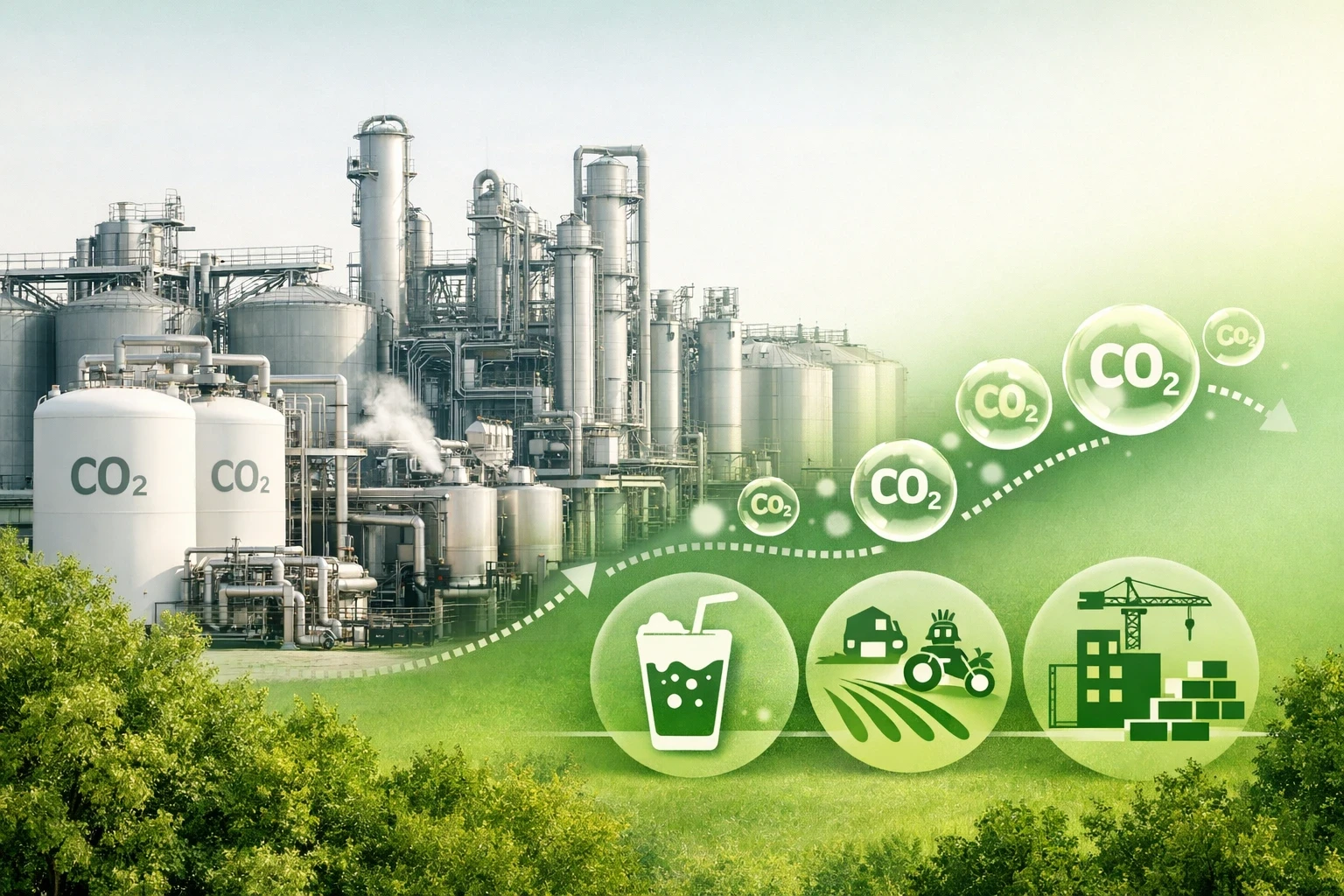
Carbon dioxide (CO₂) is usually discussed in the context of greenhouse gas emissions. But in an ethanol plant, it is also a valuable industrial product.
During the process of ethanol production, CO₂ is generated naturally through fermentation. Rather than venting this gas into the atmosphere, modern ethanol plants now capture, purify, and route it directly into the supply chains of major industries. When handled correctly, this so-called "by-product" becomes a reliable, high-margin revenue stream.
As India accelerates toward its E20 blending targets, the volume of CO₂ available from fermentation is set to grow exponentially. This is both an environmental and a significant business opportunity for producers and industrial buyers alike.
Here is how CO₂ is produced in ethanol plants, why it is uniquely valuable, and where it is used across the Indian economy.
Ethanol is produced through fermentation. Yeast converts sugars derived from feedstocks such as maize, sugarcane, or broken rice into ethanol and carbon dioxide.
The stoichiometry is straightforward:
For every 1 litre of ethanol produced, approximately 1 kg of CO₂ is generated.
This means a 100 KLPD (kilolitres per day) ethanol plant has the potential to produce 100 tonnes of CO₂ per day. Over a year of operation, that volume becomes commercially significant.
Unlike CO₂ captured from coal-fired power plants or cement kilns which is dilute and contaminated with sulphur, heavy metals, and particulates, fermentation CO₂ is biogenic and relatively clean. It originates from biological processes, not fossil fuels. However, "relatively clean" does not mean food-grade. Raw fermentation CO₂ carries volatile organic compounds (VOCs) and trace alcohols that cause odour issues.
In a well-designed recovery system, CO₂ undergoes:
This process transforms a waste gas into a certified industrial input.
Capturing CO₂ is not just about reducing emissions. It also creates practical advantages:
As global beverage and food majors commit to net-zero supply chains, biogenic CO₂ from ethanol plants is increasingly preferred over fossil-derived CO₂. Some markets already recognise this as Green CO₂, attracting a price premium.
CO₂ from ethanol plants serves a diverse and expanding set of industries. Below are the most relevant applications.
The beverage industry remains the largest consumer of food-grade CO₂ in India.
CO₂ is used for:
Food-grade CO₂ must meet strict purity standards. Ethanol plants with proper purification and deodorization systems are well-positioned to supply this premium market.
With per capita beverage consumption rising and packaged drinking water penetrating Tier-2 and Tier-3 cities, the demand gap for reliable, domestic CO₂ supply is widening.
CO₂ is critical to India's rapidly expanding cold chain and processed food sector.
CO₂ displaces oxygen in packaged food, retarding bacterial growth and extending shelf life.
Common applications include:
Solid CO₂ (dry ice) is used for:
As India invests in integrated cold chain infrastructure under schemes like the PM Kisan SAMPADA Yojana, industrial CO₂ demand is projected to grow steadily.
CO₂ is a key raw material in several chemical processes.
The largest captive consumer of CO₂ is the fertilizer industry, where CO₂ reacts with ammonia to form urea. However, this is typically an integrated operation. Merchant supply to urea plants is viable only when ethanol facilities are located in close proximity to fertiliser complexes.
Emerging technologies now enable the hydrogenation of CO₂ to produce methanol and synthetic fuels. While not yet mainstream in India, this represents a long-term avenue for CO₂ offtake.
Internationally, CO₂ is used extensively for Enhanced Oil Recovery (EOR).
In this process:
Although India’s EOR activity is limited compared to some other countries, CO₂ still plays a role in certain oilfield applications and industrial pressurization systems.
One of the most promising emerging applications is CO₂ curing in concrete.
When CO₂ is injected into fresh concrete:
It reacts with calcium compounds to form calcium carbonate
This process, known as Carbon Capture and Utilization (CCU) in construction, is gaining traction among sustainability-focused infrastructure players. With India undertaking the largest housing and infrastructure expansion in its history, this segment could become a significant offtaker.
CO₂ is a plant nutrient. In controlled-environment agriculture, CO₂ enrichment accelerates photosynthesis.
Applications:
As protected cultivation and polyhouse farming expand under Rashtriya Krishi Vikas Yojana (RKVY) , agricultural demand for industrial CO₂ is expected to rise.
For ethanol manufacturers, capturing CO₂ is not just an environmental measure, it is a commercial decision.
Installing a CO₂ recovery system allows producers to:
Instead of treating CO₂ as waste, producers can market it as an industrial product.
Companies that integrate CO₂ capture systems early often gain a competitive advantage, especially as environmental regulations become stricter.
While the opportunity is clear, there are practical considerations:
Recovery systems require expenditure on scrubbers, deodorizers, compressors, and storage spheres.
Food and pharma buyers mandate IS 307 compliance. Continuous VOC monitoring is essential.
CO₂ is transported in pressurised cylinders or cryogenic tankers. Supply reliability depends on fleet management. Logistics planning is essential for safe supply.
Long-term offtake agreements with industrial gas companies or direct end-users are necessary for consistent dispatch.
Despite these hurdles, the payback period for well-executed CO₂ recovery projects in India typically ranges from 24 to 36 months, depending on scale and market access.
Ethanol production is already part of a renewable fuel system. When CO₂ from fermentation is captured and reused, it supports better resource efficiency.
Instead of releasing CO₂ directly into the atmosphere, it is redirected into industries that need it. This reduces reliance on fossil-based CO₂ sources and supports more responsible manufacturing practices.
As India scales its biofuel capacity to meet E20 and beyond, the availability of biogenic, fermentation-derived CO₂ will expand proportionally. Industries currently reliant on CO₂ from ammonia plants or imported sources can benefit from this reliable, domestic, and cleaner supply.
CO₂ captured from ethanol production is not just a by-product. It is an industrial resource with measurable commercial and environmental value.
It supports:
For ethanol producers, CO₂ recovery offers a clear path to revenue diversification and operational resilience. For industrial buyers, it offers a dependable, domestically-produced, and increasingly preferred source of Green CO₂.
As biofuel production scales up, captured CO₂ will continue to play an important role across multiple sectors. With the right systems and partnerships in place, this by-product can contribute meaningfully to both industry growth and better resource use.
CO₂ is produced during the fermentation stage of ethanol production. When yeast converts sugars from feedstocks like maize or sugarcane into ethanol, carbon dioxide is released as a natural by-product. This CO₂ can be captured, purified, and reused for industrial applications.
CO₂ from ethanol plants is biogenic, meaning it comes from biological sources rather than fossil fuels. While it is still carbon dioxide, capturing and reusing it reduces the need to produce CO₂ from fossil-based industrial processes.
Captured CO₂ is used in several industries, including beverage carbonation, food preservation, dry ice production, fertilizer manufacturing, concrete curing, greenhouse farming, and certain chemical processes.
Yes. Raw fermentation CO₂ contains moisture and trace impurities. It must go through scrubbing, drying, filtration, and compression to meet industrial or food-grade standards.
On average, about 1 kilogram of CO₂ is generated for every litre of ethanol produced. This means large ethanol plants can produce significant volumes of CO₂ daily, making recovery commercially viable.

Get the latest updates on renewable energy, sustainability trends, and our initiatives delivered straight to your inbox.