
Subscribe to Our Newsletter
Join our community and stay updated.

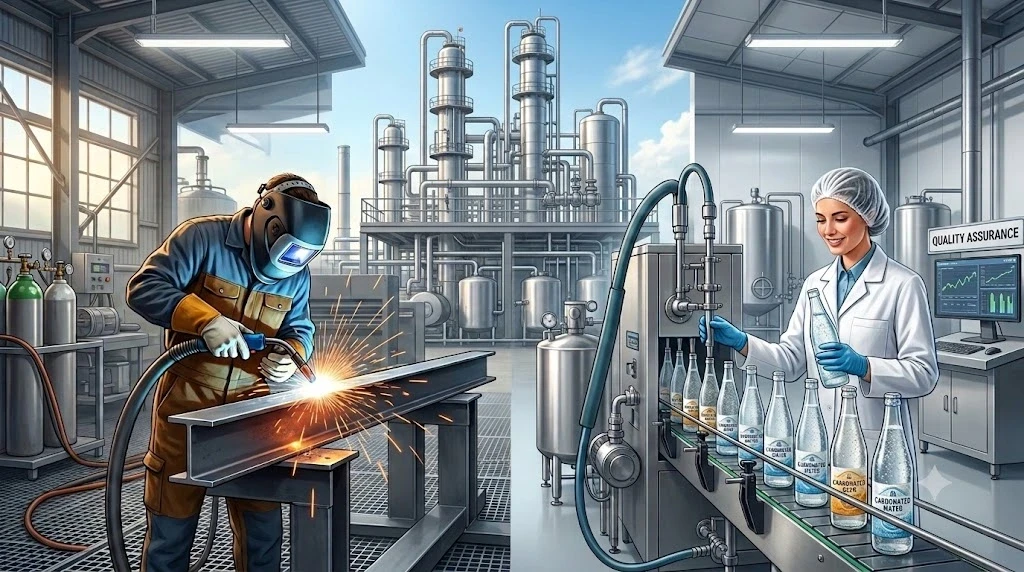
Carbon dioxide is a natural co-product of ethanol fermentation. Instead of releasing this CO₂, modern bioethanol refineries can capture, purify and supply it to different industries.
However, not all recovered CO₂ is intended for the same applications. Food-grade and industrial-grade CO₂ have different quality requirements, impurity limits and end-use considerations.
For ethanol producers, understanding these differences is important when designing CO₂ recovery systems and identifying potential markets. For buyers, knowing the required grade helps ensure that the CO₂ is suitable for the intended application.
This article explains the key differences between food-grade and industrial-grade CO₂ and what ethanol refineries and buyers should consider.
During fermentation, yeast converts sugars from feedstocks such as maize or other grains into ethanol and CO₂.
The resulting CO₂ stream can be captured from the fermentation process rather than being released into the atmosphere. However, raw fermentation CO₂ is not ready for every application.
It can contain:
The gas therefore needs to be treated, purified and tested according to its intended use.
The required level of purification depends on whether the CO₂ is intended for food and beverage applications or industrial processes.
Food-grade CO₂ is carbon dioxide that meets the quality and safety requirements necessary for applications involving food or beverages.
It is commonly used for:
The important consideration is that food-grade CO₂ is not defined only by its overall CO₂ purity. Individual impurities also matter.
Depending on the application and applicable standards, parameters such as moisture, oxygen, hydrocarbons, sulphur compounds and other trace contaminants may need to be tightly controlled.
For beverage manufacturers in particular, unwanted impurities can affect the taste, odour, appearance or safety of the final product.
This is why food-grade CO₂ requires appropriate purification, testing and handling throughout the supply chain.
Industrial-grade CO₂ is intended for applications where food-contact requirements do not apply.
Unlike food-grade CO₂, its specification is generally determined by the requirements of the specific industrial process.
The required quality can therefore vary considerably between applications.
Industrial CO₂ may be used in areas such as:
An industrial application may not require the same level of impurity control as a beverage application. However, the gas still needs to meet the technical requirements of the process. Industrial-grade does not mean low-quality. It means the CO₂ is produced and specified for an industrial application rather than a food-contact application.
The primary difference is the required specification and intended use.
Factor |
Food-Grade CO₂ |
Industrial-Grade CO₂ |
|---|---|---|
| Main purpose | Food and beverage applications | Industrial processes |
| Purity requirements | Generally more stringent | Application-dependent |
| Trace impurities | Closely controlled | Controlled according to process requirements |
| Odour/taste | Highly important | Usually less critical |
| Food contact | Suitable when applicable requirements are met | Not automatically suitable |
| Testing | Detailed quality and impurity testing | Based on application and customer specification |
| Handling | Greater emphasis on food-safety controls | Focus on technical and operational requirements |
The key point is that CO₂ should be matched to the application, not simply selected based on its overall purity percentage.
Capturing CO₂ from fermentation is only the first step. A typical recovery process may include several stages.
CO₂ generated during fermentation is collected from the fermentation system.
The gas is treated to remove unwanted components carried over from the fermentation process.
Cooling and separation processes help remove moisture and condensable substances.
Additional treatment can be used to reduce remaining impurities and achieve the required product specification.
Depending on the system, this can involve filtration, activated carbon treatment, drying and other purification technologies.
Purified CO₂ can be compressed and liquefied for storage and transportation.
The final product is tested against the specification required for its intended application. This final step is particularly important for food and beverage applications, where individual impurity limits can be critical.
No. The origin of CO₂ does not automatically determine its grade.
Although ethanol fermentation provides a useful source of recoverable CO₂, the gas must undergo suitable purification and quality control before it can be supplied for food or beverage applications.
A refinery targeting food-grade markets needs to consider:
Therefore, the statement “CO₂ comes from ethanol production” is not enough to establish that it is food-grade.
The final specification and quality-control process are what matter.
CO₂ recovery can create an additional value stream for a bioethanol refinery.
Instead of treating fermentation CO₂ simply as a by-product, producers can recover and purify it for customers with different requirements.
The potential benefits include:
However, producing a higher specification CO₂ product also requires appropriate investment in purification, testing, storage and quality management.
The right approach is to start with the application, rather than the product label. Before purchasing CO₂, businesses should consider:
Determine exactly how the CO₂ will be used and whether it will come into direct contact with food or beverages.
Review the required CO₂ purity and individual impurity limits for the application.
Ask suppliers for relevant quality data and batch testing information.
Parameters such as moisture, oxygen and other trace contaminants may be important depending on the process.
Liquid CO₂ requires suitable storage vessels and transportation systems designed for the product.
Consistent quality and dependable supply are just as important as the initial specification.
For food and beverage applications, ensure that the product meets the relevant regulatory and industry requirements.
Edhas Biofuel recovers CO₂ as a co-product of its grain-based ethanol production process. The company offers liquid CO₂ and dry CO₂/dry ice for different applications, with its CO₂ product information specifying food-grade and industrial-grade options.
For customers, the important consideration is not simply the source of the CO₂. The focus should be on the verified product specification, quality testing and suitability for the intended application.
Food-grade and industrial-grade CO₂ are both valuable products, but they serve different requirements.
For ethanol refineries, the opportunity is to capture fermentation CO₂ and process it into a product with a clearly defined specification.
For buyers, the best choice depends on the application, required purity, impurity limits, applicable standards and supply requirements.
Ultimately, the process should follow a simple principle:
By matching CO₂ quality to its intended use, ethanol producers can create greater value from fermentation while customers can obtain a product that meets their specific operational requirements.
Food-grade CO₂ is produced and controlled for applications involving food or beverages, while industrial-grade CO₂ is specified according to the requirements of industrial processes.
Not automatically. Fermentation-derived CO₂ must be appropriately purified, tested and handled to meet the requirements of food or beverage applications.
Not necessarily. Beverage applications require CO₂ that meets the applicable food-safety and impurity requirements.
Fermentation produces a significant CO₂ stream. Recovering it allows ethanol refineries to convert this co-product into a commercially useful product instead of releasing it.
Buyers should check purity, individual impurity limits, moisture, oxygen, certificate of analysis, applicable standards, storage requirements and supply consistency.
Food-grade CO₂ is commonly used in beverage carbonation, sparkling water, food processing, packaging and preservation applications.

Get the latest updates on renewable energy, sustainability trends, and our initiatives delivered straight to your inbox.