
Subscribe to Our Newsletter
Join our community and stay updated.

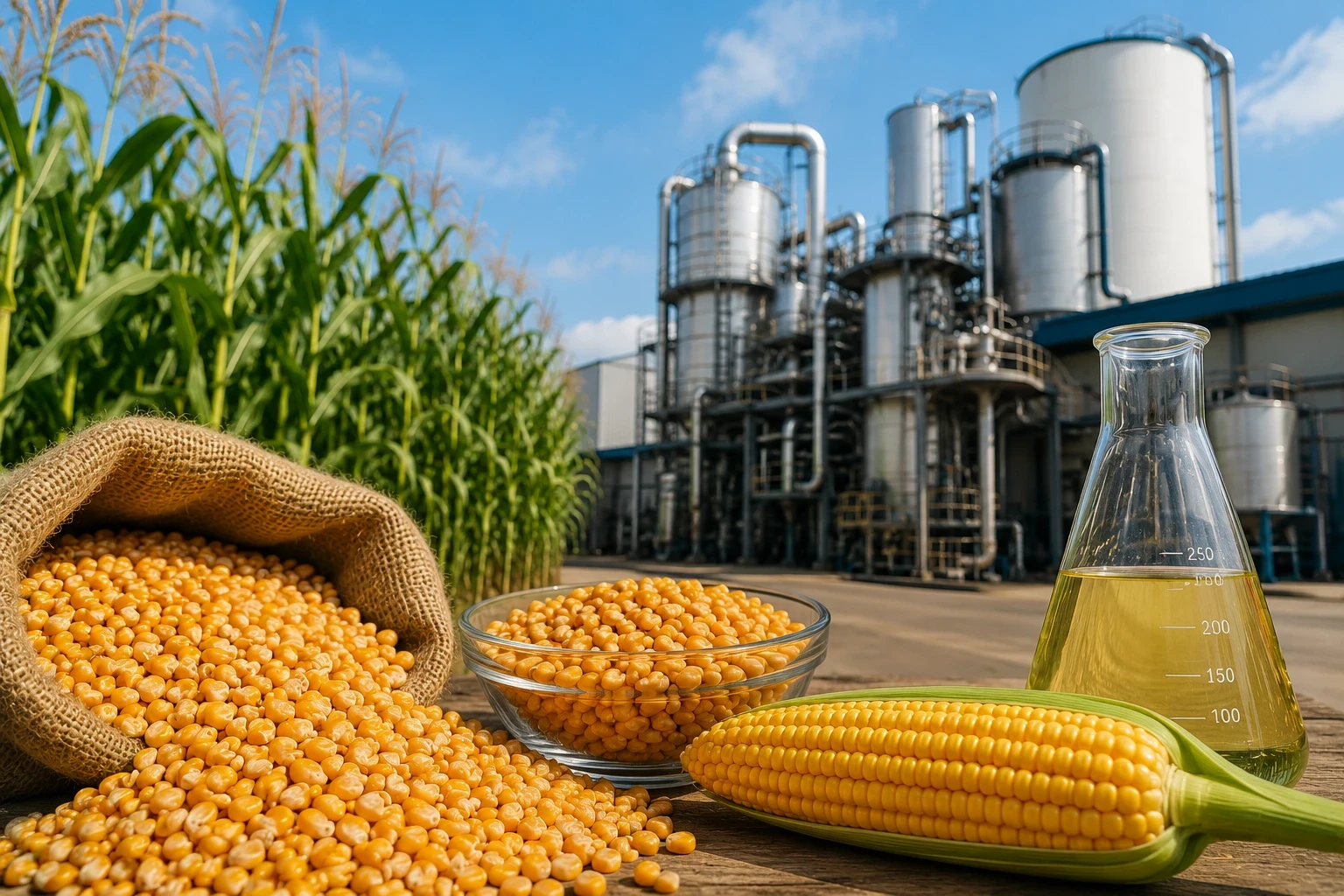
India’s ethanol industry has changed dramatically over the last few years. What was once heavily dependent on sugarcane molasses has now evolved into a more diversified and scalable ecosystem. As India pushes toward higher ethanol blending targets, the focus is no longer only on producing more ethanol, it is also about choosing the right feedstock to support long-term growth sustainably.
Among all the available options such as broken rice, wheat, barley, sorghum, and sugarcane derivatives, one crop has steadily emerged as the most practical choice: maize.
Today, many grain-based ethanol plants across India rely on maize as their primary raw material. This shift is being driven by a combination of higher ethanol yield, year-round availability, better co-product economics, policy support, and operational reliability.
In ethanol production, a feedstock is the raw material used to manufacture ethanol. It is the agricultural material that gets processed, fermented, and distilled into fuel-grade ethanol.
Different feedstocks vary in:
Globally, countries use different feedstocks depending on climate and agricultural patterns. Brazil largely depends on sugarcane, while the United States primarily uses corn or maize. India historically relied on molasses from sugarcane. However, grain-based ethanol vs sugarcane ethanol has been an evolving conversation. Grain-based ethanol, especially maize-based ethanol, has gained strong momentum in recent years.
The choice of feedstock directly impacts:
So when maize is described as the “preferred” feedstock, it is based on measurable operational and economic advantages rather than simple preference.
For decades, ethanol production in India was closely linked to the sugar industry. Distilleries were usually attached to sugar mills, and molasses served as the main feedstock.
But this model had limitations:
The National Policy on Biofuels, 2018 changed this by encouraging the use of surplus food grains such as maize, broken rice, and wheat for ethanol production.
One of maize’s biggest advantages is its high starch content.
Maize typically contains around 65–72% starch, which converts efficiently into fermentable sugars during processing.
In practical terms:
For large ethanol plants, even a small increase in yield can make a major difference in profitability.
Higher recovery means:
Continuous feedstock supply is critical for ethanol plants.
Maize also stores well in silos, allowing plants to maintain stable supply throughout the year. This makes maize far more suitable for continuous industrial-scale operations.
Maize is cultivated across several Indian states, including:
This diversified geographic spread reduces supply chain risk.
If one region faces poor rainfall or lower yields, supply from other regions can help balance availability.
For ethanol plants located close to maize-growing belts, it also reduces transportation costs.
Feedstock cost is the single biggest factor affecting ethanol production economics.
Maize benefits from India’s Minimum Support Price (MSP) system, which provides a pricing benchmark and greater predictability.
Although market prices still fluctuate, maize pricing tends to remain more stable than several alternative feedstocks.
This helps ethanol producers:
India’s ethanol growth has been strongly policy-driven.
The GOI has actively encouraged grain-based ethanol production by:
Oil Marketing Companies (OMCs) such as Indian Oil, BPCL, and HPCL regularly procure ethanol produced from maize-based distilleries.
This policy clarity gives producers confidence to invest in long-term infrastructure. Understanding the impact of bioethanol as a cleaner fuel further explains why government support continues to grow.
Maize-based ethanol production generates multiple valuable co-products, making the overall business model stronger.
These include:
These co-products help offset raw material costs and improve plant profitability.
This is why modern maize-based ethanol plants are increasingly being seen as integrated biorefineries rather than just ethanol manufacturing units.
Sugarcane is one of the most water-intensive crops grown in India.
Maize requires significantly less water, making it a more sustainable option in regions facing groundwater stress and irrigation challenges.
As sustainability becomes more important in India's energy and agricultural policies including the broader role of biomass and bioenergy, this advantage will become even more relevant.
Parameter |
Maize |
Broken Rice |
Sugarcane Molasses |
|---|---|---|---|
| Starch / Sugar Content | ~68–72% starch | ~75–80% starch | Sugar-based |
| Ethanol Yield (litres/tonne) | High (~380–400) | Moderate-High (~370–385) | Lower (~220–280) |
| Year-Round Availability | High | Moderate (policy-dependent) | Low (seasonal) |
| Co-Product Value | High (DDGS, corn oil, CO₂) | Moderate | Limited |
| Water Requirement | Moderate | Low | Very High |
| Price Stability | Good (MSP-backed) | Variable | Variable |
| Geographic Spread | Wide | Limited | Concentrated |
The comparison clearly shows why maize has become the preferred choice for many ethanol producers, and why the carbon footprint of ethanol vs petrol makes this shift environmentally significant as well.
→ It may not dominate every single category, but it performs consistently well across efficiency, availability, scalability, and economics.
Despite its advantages, maize-based ethanol production is not without challenges.
Indian maize production is still influenced by rainfall patterns. Poor monsoons can affect yields and increase procurement prices.
Maize is also widely used in poultry feed, animal feed, and food processing. Rising ethanol demand can increase competition for supply.
Maintaining year-round maize availability requires proper storage systems such as modern silos with moisture and temperature control.
Although maize is cultivated widely, surplus supply is concentrated in specific regions. Transporting grain over long distances can impact overall economics.
However, the industry is steadily addressing these challenges through better procurement systems, storage infrastructure, and farmer partnerships.
As India continues expanding its ethanol blending programme, feedstock demand will rise significantly.
Maize is well-positioned to support this growth because of:
Research is also underway on high-starch maize varieties and second-generation ethanol technologies that could eventually utilize maize crop residues as additional feedstock.
Maize is no longer just an alternative option, it is becoming one of the foundations of India’s biofuel future.
When evaluating what makes an ideal ethanol feedstock: yield efficiency, availability, scalability, price stability, sustainability, and co-product value, maize consistently stands out as one of the strongest options available in India today.
Other feedstocks such as broken rice and wheat will continue contributing to India’s ethanol ecosystem. But for distilleries aiming for reliable year-round production and stronger long-term economics, maize offers the most balanced and practical solution.
At Edhas Biofuel Refinery, maize plays a central role in our integrated production model. It supports ethanol manufacturing, DDGS production for the animal feed industry, and corn oil extraction, enabling a circular and efficient sustainable energy ecosystem.
As India’s biofuel ambitions continue to grow, maize is set to remain at the centre of the country’s ethanol journey.
Maize is preferred because it offers high ethanol yield, year-round availability, strong co-product value, and better scalability for grain-based ethanol production in India.
Ethanol production from maize involves converting maize starch into fermentable sugars, followed by fermentation and distillation to produce fuel-grade ethanol.
On average, 1 tonne of maize can produce around 380–400 litres of ethanol, making ethanol from maize highly efficient compared to many other feedstocks.
Maize for ethanol production in India offers stable supply, lower water usage than sugarcane, strong government support, and valuable co-products like DDGS and corn oil.
Grain-based ethanol in India refers to ethanol produced using grains such as maize, broken rice, and wheat instead of traditional sugarcane molasses.

Get the latest updates on renewable energy, sustainability trends, and our initiatives delivered straight to your inbox.