
Subscribe to Our Newsletter
Join our community and stay updated.

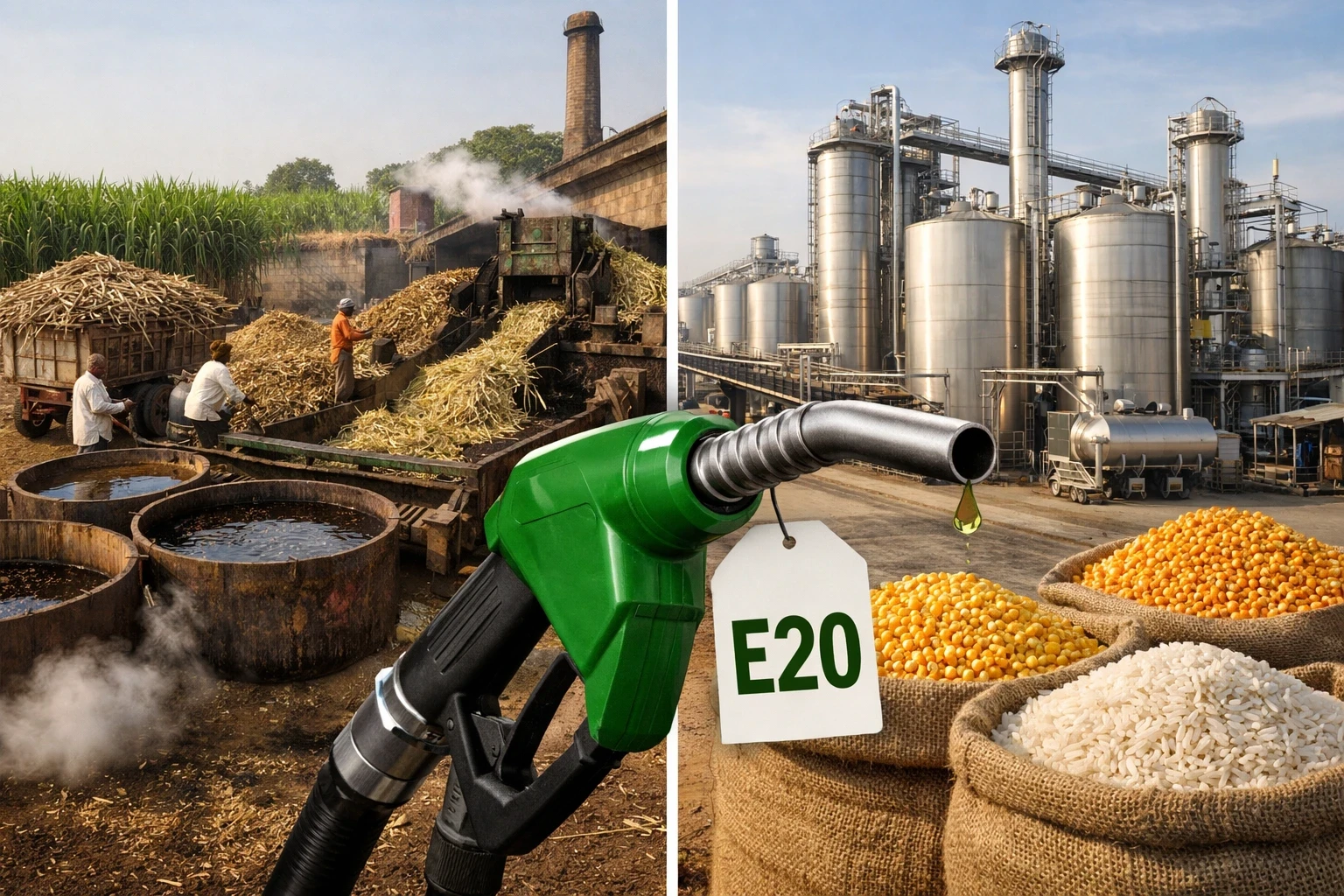
When people talk about ethanol in India, they usually think of sugarcane. Today, that’s no longer the full picture. More than two-thirds of the ethanol blended into petrol now comes from grains. How did that shift happen, and why does it matter?
India achieved 20% ethanol blending (E20) in 2025, five years ahead of schedule. This wasn’t the result of scaling a single feedstock, but of expanding production into grain-based ethanol.
This article explains the difference between grain-based and sugarcane-based ethanol, how each is produced, their yields, byproducts, and why India is shifting toward grains.
The main difference between the two lies in the raw material used.
Produced from:
Produced from:
Grains contain starch, not sugar.
This starch must first be converted into fermentable sugars before ethanol can be produced.
This difference: sugar already present versus starch that needs conversion, is what makes the two production processes distinct.
Both methods produce fuel-grade ethanol (99.9% purity), but the steps involved are different.
This is a shorter process because fermentable sugars are already available.
Grain-based production includes additional steps before fermentation:
These additional steps increase complexity but improve overall output.
Explore in detail: How Ethanol is Made
Grain-based feedstocks produce more ethanol per tonne:
Feedstock |
Ethanol Yield (Litres/Metric Tonne) |
| Broken Rice |
~420 |
| Maize | ~380 |
| Sugar Syrup |
~300–320 |
| C-Heavy Molasses |
~220–250 |
Higher yield is one of the key reasons behind the shift toward grains.
Ethanol is the primary product, but byproducts play a major role in overall efficiency and economics.
Grain-based distilleries generate higher-value co-products. DDGS, in particular, has strong demand in India’s livestock and poultry sectors.
At Edhas Biofuel, these outputs are integrated into operations, ensuring that each byproduct is utilised rather than treated as waste.
Government pricing has directly influenced the shift toward grain-based ethanol
Feedstock |
Price (₹/litre) |
| Maize |
₹71.86 |
| Cane Juice/Syrup |
₹65.61 |
| B-Heavy Molasses |
₹60.73 |
| FCI Rice |
₹58.50 |
| C-Heavy Molasses |
₹57.97 |
Maize-based ethanol receives the highest price. This pricing structure was designed to encourage investment in grain-based distilleries beyond traditional sugarcane regions.
As a result, over ₹40,000 crore has been invested in grain-based capacity across multiple states. By ESY (Ethanol Supply Year) 2024–25, grain-based feedstocks accounted for around 69% of ethanol supplied to oil marketing companies (OMCs), with maize alone contributing about 48%.
For most of the programme's early history, sugarcane was India's primary ethanol feedstock. So what changed?
Weak sugarcane seasons in 2023–24 and 2024–25 caused sugar output to drop from a record 359 lakh tonnes in 2021–22 to an estimated 261 lakh tonnes in 2024–25. To protect domestic supply, the government restricted diversion of cane juice and B-heavy molasses for ethanol, highlighting the risks of relying on a single crop.
Using cane juice for ethanol reduces sugar availability. Grain-based ethanol avoids this issue by using:
This makes grain-based ethanol easier to manage during supply constraints.
Grains produce more ethanol per tonne compared to molasses, improving efficiency.
Sugarcane cultivation is region-specific. Grain-based ethanol allows participation from states such as Bihar, Madhya Pradesh, Punjab, Andhra Pradesh, and Chhattisgarh, expanding farmer income opportunities.
Sugarcane processing is seasonal. Grain-based distilleries can operate throughout the year, improving capacity utilisation.
It depends on the criteria.
India’s approach is not to replace one with the other, but to use both in balance.
Grain-based ethanol now dominates supply:
Total demand: 1,050 crore litres
Total offers: 1,776 crore litres
This reflects a clear shift, while maintaining a dual-feedstock system.
To move beyond E20 blending, India will need:
Diversification will remain central to the programme.
Edhas Biofuel operates in the grain-based ethanol segment using maize and broken rice.
The focus is on full resource utilisation:
This approach ensures that every output has a defined use.
India’s ethanol blending success is built on diversification. Moving from a sugarcane-dominated system to one that includes grains has improved supply stability, increased output, and expanded participation across regions.
Grain-based ethanol is not replacing sugarcane, it is strengthening the system by reducing risk and improving efficiency.
Grain-based ethanol is made from starch-rich crops like maize and broken rice, while sugarcane-based ethanol is produced from molasses, cane juice, or syrup that already contain fermentable sugars.
India is shifting to grains due to higher ethanol yield, better pricing, year-round production, and reduced dependence on sugarcane.
Grain-based feedstocks like broken rice and maize produce more ethanol per tonne compared to molasses and sugar syrup.
Grain-based ethanol produces DDGS (animal feed), maize oil, CO₂, and fly ash, many of which have commercial value.
No, sugarcane-based ethanol is still important. India is moving toward a balanced mix of both grain and sugarcane feedstocks.

Get the latest updates on renewable energy, sustainability trends, and our initiatives delivered straight to your inbox.