
Subscribe to Our Newsletter
Join our community and stay updated.

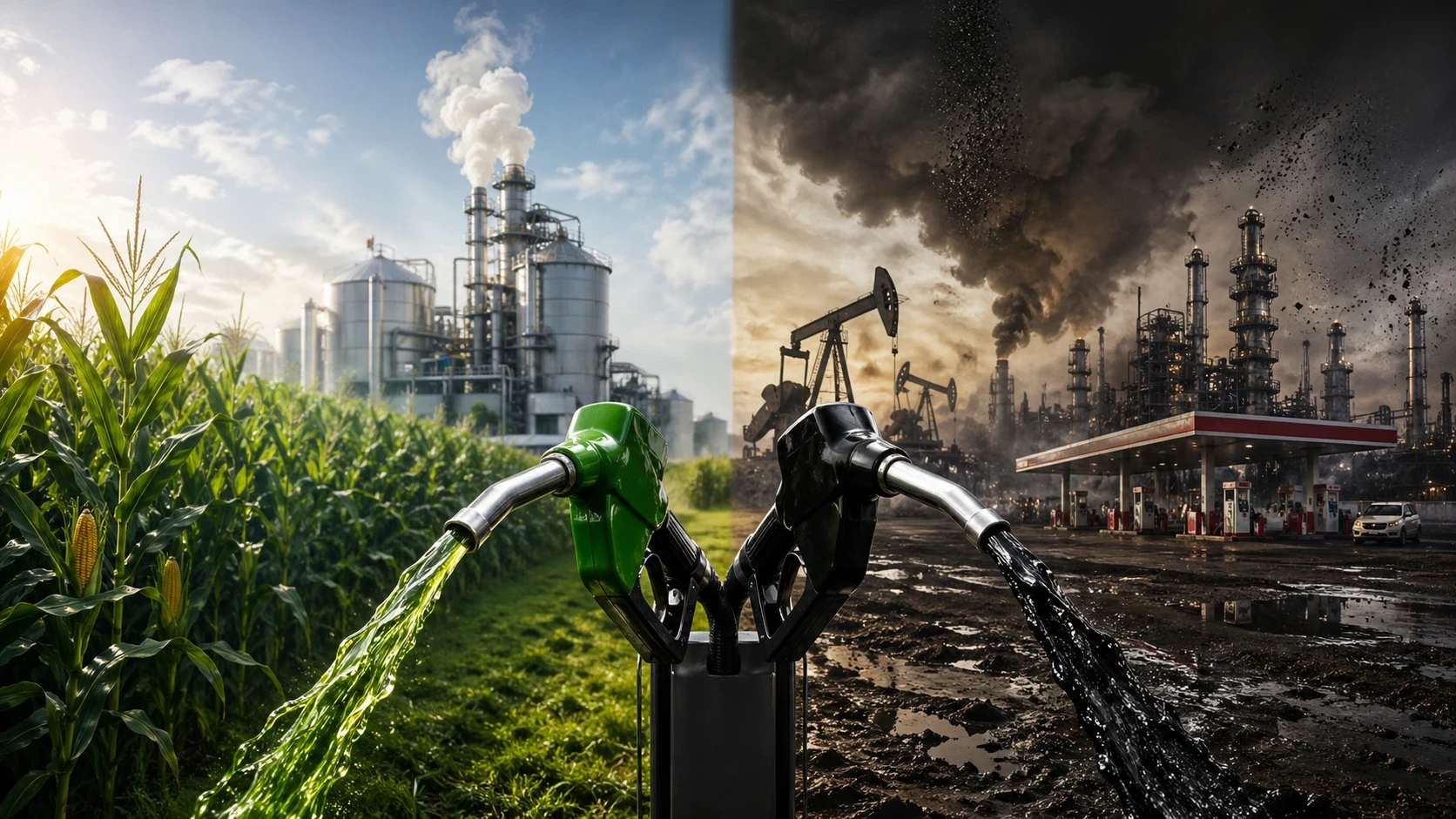
India crossed a major milestone in 2023 by achieving 10% ethanol blending in petrol nationwide, and the country is now moving steadily toward its E20 (20% blending) target.
But beyond the headline numbers lies a more important question:
Does ethanol actually reduce carbon emissions compared to petroleum fuel?
The short answer is yes, but the reality is more nuanced. To understand the true impact, we need to look beyond tailpipe emissions and examine the entire lifecycle of both fuels.
When people think about emissions, they usually focus on what comes out of a vehicle’s exhaust. But that’s only part of the story.
A fuel’s real carbon footprint includes:
This full-lifecycle approach is known as Well-to-Wheel (WtW) analysis, which measures emissions in grams of CO₂ equivalent per megajoule of energy (gCO₂eq/MJ).
This method allows a truly equal footing for comparing fuels.
Petroleum fuel begins deep underground and goes through multiple energy-intensive stages before reaching your vehicle.
By the time petrol is burned, a large share of emissions has already occurred, often 15–20% of the total.
For India specifically:
Grain-based ethanol follows a fundamentally different pathway.
Unlike petroleum, grain-based ethanol production generates useful co-products:
These outputs displace other carbon-intensive products, further lowering overall emissions.
Factor |
Petroleum Fuel |
Grain-Based Ethanol |
|---|---|---|
| Lifecycle CO₂ emissions (global avg) | ~85–95 gCO₂eq/MJ | ~45–60 gCO₂eq/MJ |
| India-specific range | ~85–95 (mostly imported) | ~50–70 depending on distillery energy source |
| Source | Finite fossil fuel | Renewable crops |
| CO₂ reabsorption | None | Yes (during crop growth) |
| Methane & N₂O emissions | Low from extraction | Possible from fertilisers (mitigable) |
| Energy return on investment (EROI) | ~10:1 | ~2–3:1 (offset by co-products) |
| Import dependency (India) | ~85% imported | Largely domestic |
| By-products | Minimal | DDGS, corn oil, CO₂, fly ash |
| Combustion pollutants | Higher | Lower particulates |
Grain-based ethanol reduces lifecycle emissions by 30–50% compared to petrol. Though in India, distilleries using coal-fired heat may see reductions at the lower end of that range, while those using biomass or solar achieve the higher end.
India’s E20 target is more than just an energy policy, it has real environmental and economic implications.
Every litre of ethanol blended:
Ethanol is cleaner, but not carbon-free. A balanced view matters.
Key challenges include:
The distillation process requires heat and electricity. If that energy comes from coal or gas, it adds to the overall footprint. Distilleries that shift to biomass boilers or renewable electricity reduce their emissions considerably. In India, the carbon intensity of ethanol can range from ~50 gCO₂eq/MJ (biomass-powered) to ~70 gCO₂eq/MJ (coal-powered).
Growing grain requires fertilisers, water, and farm machinery which add carbon costs. Beyond CO₂, nitrogen-based fertilisers can release nitrous oxide (N₂O), a greenhouse gas nearly 300 times more potent than CO₂. Methane from rice paddies (if broken rice is sourced from flooded fields) is another factor. Both are manageable through better farming practices but must be accounted for.
If ethanol production displaces food crops or leads to deforestation, carbon savings can be partially eroded. India’s current policy directs surplus and damaged grain toward ethanol, which avoids most of this risk but it remains worth monitoring as production scales.
Current Mitigation (India): Focus on surplus and damaged grain, reducing the risk of a food vs fuel conflict.
The next phase of ethanol growth will focus on lowering emissions further.
Key innovations include:
India’s Biofuels Policy roadmap to 2030 aligns with all these advancements. The trajectory is clearly toward cleaner ethanol, not just more of it.
When evaluated on a lifecycle basis, the conclusion is clear:
Yes, there are challenges but they are solvable and improving over time.
Petroleum, by contrast, has fixed emissions with no long-term pathway for reduction.
Ethanol (produced responsibly from grain) is already a cleaner alternative and it’s only getting better.
At Edhas Biofuel, we produce fuel-grade ethanol using locally sourced maize and broken rice. Our production process is designed to maximise output and minimise waste. Every co-product from our facility, from DDGS to captured CO₂, is put to productive use.
We are committed to supporting India’s transition toward cleaner, more sustainable energy.
Yes, grain-based ethanol produces 30–50% lower lifecycle carbon emissions than petrol, making it a cleaner fuel alternative.
Petrol emits around 85–95 gCO₂eq/MJ, while ethanol emits 45–60 gCO₂eq/MJ, depending on production methods.
Ethanol reduces emissions through the biogenic carbon cycle, where crops absorb CO₂ during growth, lowering net emissions.
E20 refers to 20% ethanol blending in petrol, which helps reduce emissions and lowers crude oil imports.
Yes, especially when produced from surplus or damaged grain, making it a more sustainable and domestically sourced fuel.

Get the latest updates on renewable energy, sustainability trends, and our initiatives delivered straight to your inbox.