
Subscribe to Our Newsletter
Join our community and stay updated.

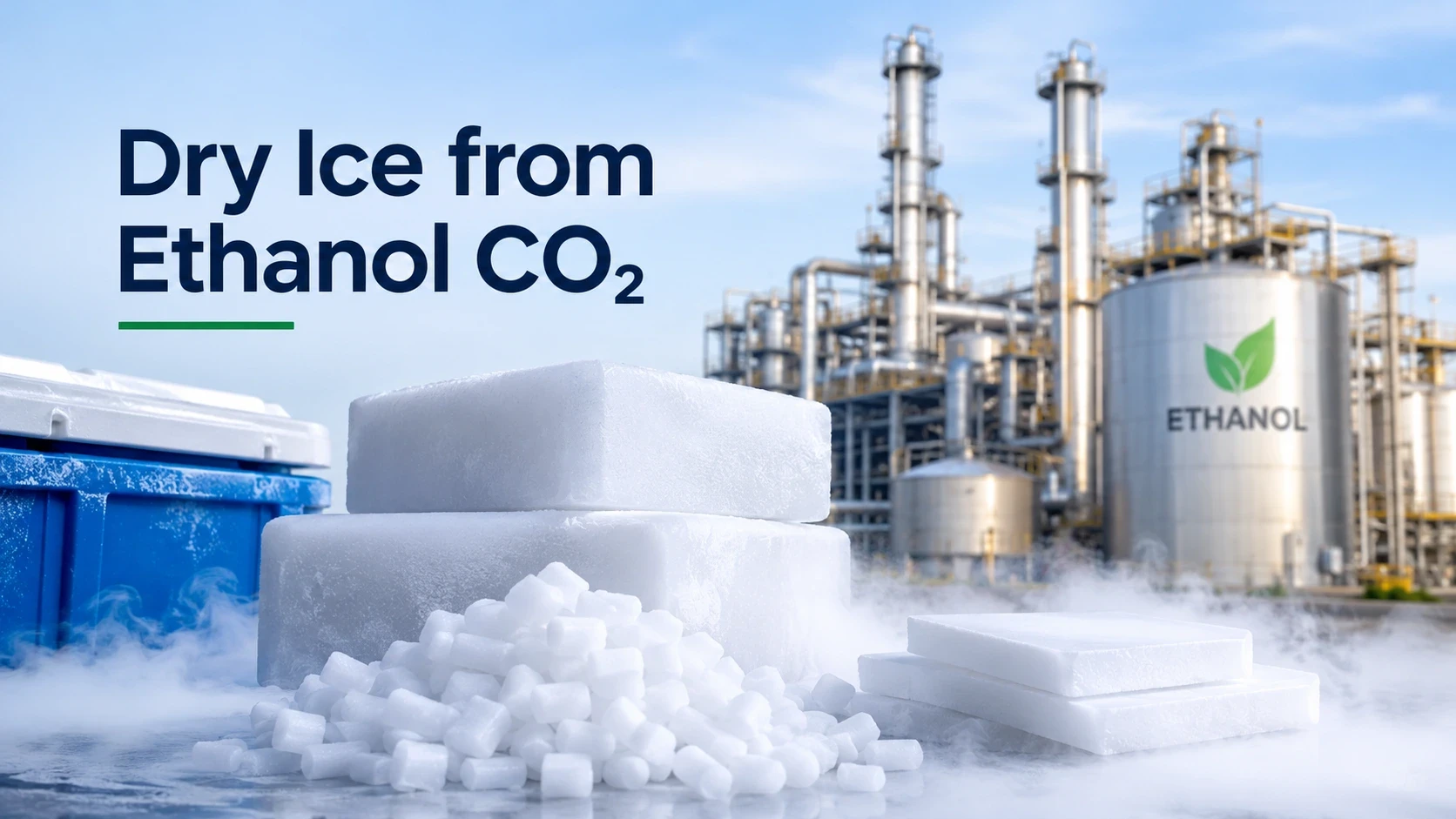
From vaccine shipments and seafood deliveries to ice cream transportation, maintaining the right temperature is essential across supply chains. One material that makes this possible is dry ice.
Interestingly, a growing opportunity for dry ice production comes from an unexpected source: ethanol production.
During grain fermentation, ethanol plants generate significant quantities of carbon dioxide (CO₂). Instead of releasing this gas into the atmosphere, manufacturers can capture, purify and convert it into liquid CO₂ and solid dry ice.
But how does this process work? What types of dry ice are available, and where are they used?
This guide explores how dry ice is manufactured from ethanol CO₂, its applications across Indian industries, and what businesses should consider when choosing a reliable bulk dry ice manufacturer.
Dry ice is carbon dioxide in solid form. At normal atmospheric pressure it does not melt into water. It sublimes, turning straight from solid to gas at about -78.5°C, which is why it leaves no liquid behind.
This extremely low temperature makes it an effective cooling agent for applications requiring consistent sub-zero temperatures.
Dry ice also offers two important advantages:
These properties make dry ice particularly useful for cold-chain logistics, food preservation, pharmaceutical transportation and industrial cleaning.
The only difference between a block of dry ice and the CO₂ in a soft drink is its state and temperature. The quality of the dry ice depends almost entirely on the quality of the CO₂ it is made from.
Carbon dioxide used in industrial applications can come from several sources, including chemical manufacturing, natural CO₂ reserves and fermentation processes. Ethanol fermentation is particularly suitable for CO₂ recovery because it produces a relatively concentrated stream of carbon dioxide.
Here is why it is a valuable source:
Recovering this gas creates an additional industrial product while improving the utilisation of resources within the ethanol manufacturing process.
For a closer look at the purification side, see our guide to CO₂ recovery and purification in ethanol fermentation.
Converting fermentation CO₂ into dry ice involves several stages of recovery, purification and processing.
Carbon dioxide released during grain fermentation is collected through a dedicated gas recovery system. This prevents the gas from being directly vented and makes it available for further processing.
The captured gas passes through purification equipment to remove ethanol vapours, moisture, odours and other impurities. Scrubbers and activated carbon filters help improve its quality.
The purified CO₂ is compressed and passed through drying systems to reduce moisture content. Proper dehydration is essential for maintaining product quality and protecting downstream equipment.
The compressed gas is cooled under suitable pressure conditions until it converts into liquid carbon dioxide (LCO₂).
The liquid CO₂ is stored in insulated tanks designed to maintain the required pressure and temperature until it is supplied or used for dry ice production.
When liquid CO₂ is rapidly expanded to atmospheric pressure, a portion converts into gas while the remaining CO₂ forms fine snow at approximately -78.5°C.
This snow is compressed using specialised equipment to manufacture dry ice pellets, blocks or slices. The released CO₂ gas can also be recovered and reused within the production system.
The finished dry ice is packed in insulated containers and dispatched for industrial or commercial applications.
Dry ice is available in different shapes and sizes depending on the cooling requirements of the application.
Form |
What It Is |
Common Applications |
|---|---|---|
| Dry Ice Pellets | Small cylindrical pieces, typically about 3 mm to 16 mm (available in different diameters) | Food packaging, pharmaceutical shipments, dry ice blasting, fog effects |
| Dry Ice Blocks | Large, compact solid slabs | Long-distance transportation, bulk cooling and cold-chain logistics, insulated crates |
| Dry Ice Slices / sheets | Thin, flat pieces cut from larger blocks | Food packaging, insulated boxes and layered cooling applications |
Pellets offer faster cooling because of their greater surface-area-to-volume ratio, but they also sublimate faster. Blocks generally last longer and are better suited to applications requiring extended cooling.
The right choice depends on shipment duration, insulation quality, required temperature and handling conditions.
Dry ice supports several industries where conventional refrigeration may not be practical or sufficient.
Food manufacturers, distributors and retailers use dry ice to transport frozen foods, seafood, meat, dairy products and ice cream. It is particularly useful for last-mile deliveries and shipments requiring temporary temperature control.
Vaccines, biological samples, medical materials and certain pharmaceutical products require strict temperature management. Dry ice helps maintain low temperatures during transportation and storage when the product's specified temperature range permits its use.
Dry ice blasting uses compressed air to propel dry ice pellets against contaminated surfaces. The pellets remove dirt, grease, paint and industrial residue before sublimating.
This process produces no secondary water or spent abrasive media, making it useful for machinery, manufacturing equipment and industrial maintenance.
Dry ice is commonly used to create dense fog effects for stage performances, exhibitions, entertainment venues and special events. It is also used for specialised food and beverage cooling applications.
Farmers, seafood distributors and fishing businesses use dry ice to help preserve perishable produce and maintain low temperatures during transportation from harvesting locations to markets.
Although both types are made from solid carbon dioxide, their intended applications and quality requirements differ.
Parameter |
Food-Grade Dry Ice |
Industrial-Grade Dry Ice |
|---|---|---|
| CO₂ Quality | Meets applicable food and beverage purity specifications | Meets specifications for its intended industrial application |
| Typical Applications | Food processing, food transportation and beverage-related uses | Industrial cleaning, blasting and general cooling |
| Quality Requirements | Strict limits for specified contaminants and moisture | Depends on the industrial process |
Food-grade dry ice should be manufactured using CO₂ that meets the relevant food-safety and purity requirements. Industrial-grade dry ice is suitable for applications where food-contact specifications are not required.
Businesses should always verify the CO₂ grade, quality certificates and applicable compliance documents before purchasing.
For more on the difference, read our guide on food-grade vs industrial-grade CO₂.
Dry ice requires careful handling because of its extremely low temperature and continuous release of CO₂ gas.
Important precautions include:
Recovering CO₂ from ethanol fermentation offers an opportunity to convert an industrial by-product into a commercially useful material.
Instead of allowing fermentation CO₂ to escape directly into the atmosphere, ethanol plants can capture and process it into liquid carbon dioxide and dry ice.
This approach supports:
However, dry ice releases its CO₂ back into the atmosphere during sublimation. Therefore, CO₂ recovery and dry ice production should be viewed as resource utilisation rather than permanent carbon removal.
Edhas Biofuel Refinery recovers CO₂ from its grain-based ethanol process in Gujarat and supplies it as liquid CO₂ and dry CO₂ (solid dry ice), in food-grade and industrial-grade options.
Here is what buyers can expect:
Whether you operate a food processing unit, pharmaceutical distribution business, cold-chain logistics company or industrial cleaning facility, choosing the right CO₂ supplier is important for maintaining product quality and operational efficiency.
Regular ice is frozen water that melts at 0°C into liquid. Dry ice is frozen carbon dioxide at about -78.5°C that turns directly into gas. It is far colder and leaves no liquid residue.
Yes. CO₂ captured during ethanol fermentation can be purified, liquefied and converted into dry ice. Fermentation CO₂ is already high in purity, which makes it well suited to food-grade dry ice.
Food-grade dry ice made from beverage-grade CO₂ is intended for use around food and is widely used in food logistics. Industrial-grade dry ice should not be used where it touches or contaminates food. Always check the grade and the supplier's documents, and follow the food-safety rules that apply to your business.
It depends on the form, the insulation and the outside temperature. Pellets sublimate faster than blocks. In a thin box it may be gone within hours, while a well-insulated container can hold it for a day or more.
Yes, with the right packaging, venting and labelling. Dry ice is a regulated dangerous good in air transport, so check requirements with your carrier before shipping.
Minimum quantities depend on the grade and form you need. Contact the Edhas Biofuel team with your requirement for current availability and pricing.

Get the latest updates on renewable energy, sustainability trends, and our initiatives delivered straight to your inbox.
