
Subscribe to Our Newsletter
Join our community and stay updated.

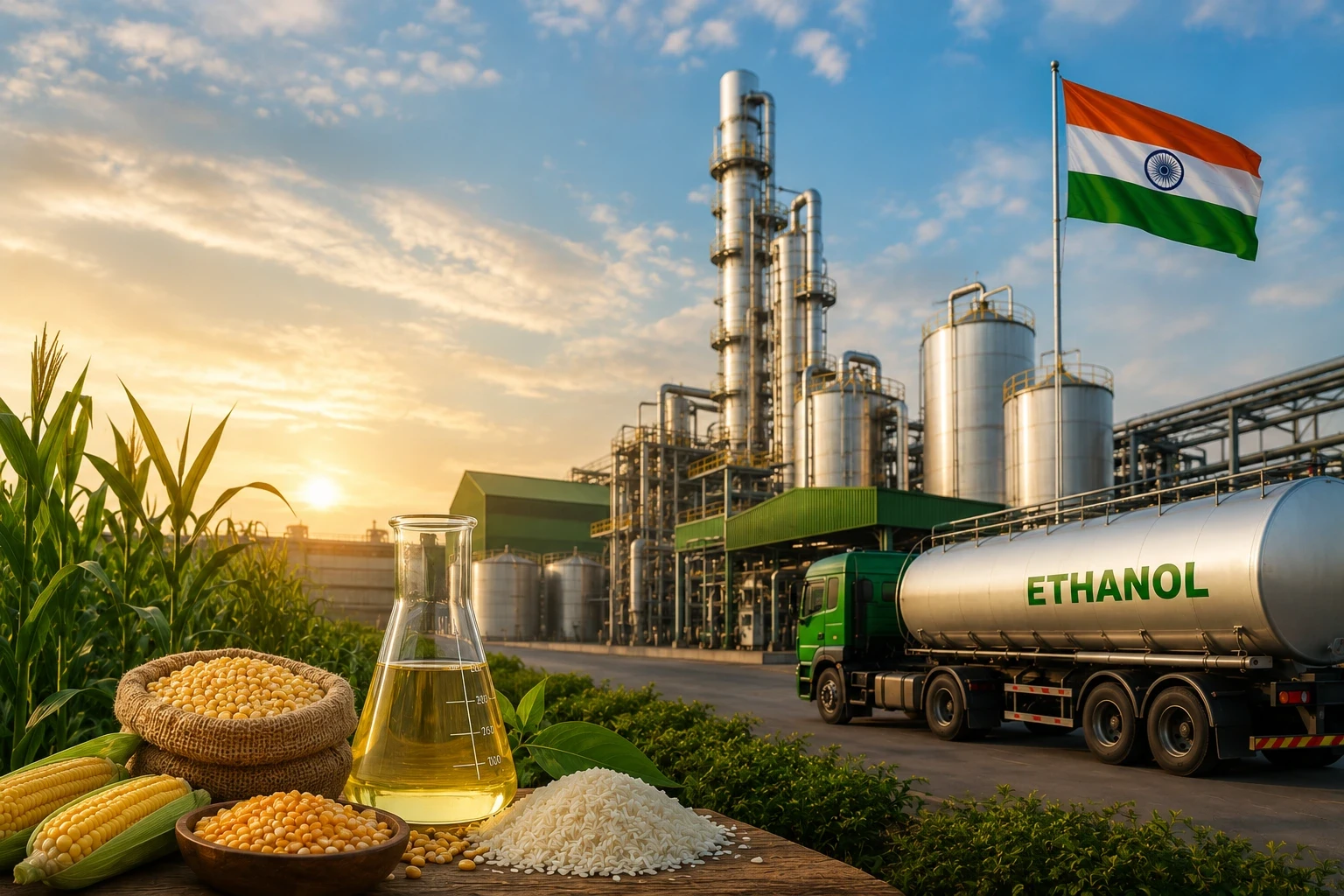
A few years ago, when people talked about ethanol in India, the conversation was dominated by states like Uttar Pradesh and Maharashtra.
Today, that picture is changing.
Gujarat is quietly becoming one of India's most significant states for ethanol manufacturing. New plants are being announced, investments are increasing, and the state's contribution to India's biofuel ecosystem is growing steadily. By June 2025, Gujarat had achieved an ethanol blending rate of 18.9%, placing it among the leading states supporting India's ambitious ethanol blending programme.
For businesses involved in fuel, agriculture, logistics, or industrial manufacturing, Gujarat's rise as an ethanol hub is worth paying attention to.
India's push towards cleaner fuels has significantly increased demand for ethanol. Through the Ethanol Blended Petrol (EBP) Programme, the government has accelerated blending targets, from E10 to E20 and beyond to reduce crude oil imports, improve energy security, and support rural economies.
As blending levels move closer to the national target of 20%, Oil Marketing Companies (OMCs) require larger and more reliable ethanol supplies. Understanding how bioethanol supports cleaner fuel alternatives helps explain why this demand is structural, not cyclical. This growing demand has encouraged companies to invest in new production facilities across the country.
While traditional ethanol-producing states continue to play a major role, Gujarat has emerged as a preferred location for the next wave of investments.
Unlike Uttar Pradesh or Maharashtra, Gujarat is not among India's largest producers of sugarcane or grain.
However, successful ethanol manufacturing depends on far more than crop production. Reliable infrastructure, efficient logistics, stable utilities, and business-friendly policies often determine whether a plant can operate profitably.
This is where Gujarat stands out.
The state offers a combination of industrial infrastructure, port connectivity, policy support, and supply-chain efficiency that few regions can match.
Those evaluating grain-based vs sugarcane-based ethanol will find Gujarat's grain-processing model particularly well-suited to the state's logistics strengths.
Ethanol production relies on feedstocks such as maize, broken rice, and sugarcane derivatives.
Although Gujarat does not produce enough grain to meet the full demand of its growing ethanol industry, it is strategically positioned near major agricultural states. Large quantities of maize (for producing ethanol) can be transported efficiently from Madhya Pradesh and Maharashtra through established rail networks.
The state's ports add another layer of flexibility.
Ports such as Mundra and Kandla allow companies to source feedstocks from domestic and international markets whenever local supply becomes constrained. This reduces dependence on a single source and helps maintain stable production throughout the year.
For ethanol manufacturers, supply-chain resilience is often as important as feedstock availability itself.
Setting up a large manufacturing facility often involves multiple approvals related to land, power, water, and environmental compliance.
Gujarat has built a reputation for simplifying this process through streamlined industrial policies and single-window clearance mechanisms. Investors benefit from faster approvals and a regulatory environment that has remained relatively consistent over time.
Policy stability is particularly important in ethanol manufacturing, where projects often require investments running into hundreds of crores of rupees.
The confidence of investors is evident in the growing project pipeline. Multiple companies have already received approvals to establish ethanol production facilities in Gujarat, representing thousands of crores in planned investments and substantial new production capacity.
Ethanol production is resource-intensive.
Both fermentation and distillation require large volumes of water and uninterrupted power. Any disruption can affect productivity, increase costs, and impact plant economics.
Over the last two decades, Gujarat has invested heavily in industrial infrastructure, including water distribution networks, canals, pipelines, and power systems that support large-scale manufacturing.
Many new ethanol plants in the state have also adopted Zero Liquid Discharge (ZLD) technology, recycling most of the water they use. This cuts costs and addresses the state's naturally dry climate.
Combined with dependable electricity supply in major industrial corridors, this infrastructure allows plants to operate efficiently around the clock.
Grain-based ethanol production also creates by-products such as Dried Distillers Grains with Solubles (DDGS), corn oil, and carbon dioxide (CO₂). These products can contribute significantly to overall profitability.
Gujarat's strong dairy, poultry, food processing, and beverage industries create ready markets for these by-products.
DDGS serves as a high-protein animal feed ingredient, while captured CO₂ can be supplied to food and beverage manufacturers. This local demand allows ethanol producers to monetize multiple output streams rather than relying solely on fuel ethanol sales.
The state's broader bioeconomy is also evolving. Companies and cooperatives are exploring second-generation (2G) ethanol methods using alternative feedstocks, further strengthening the ecosystem.
One of Gujarat's most significant advantages is its access to global trade routes.
Ports such as Mundra, Kandla, and Pipavav connect manufacturers to markets across Africa, the Middle East, and Southeast Asia.
This connectivity benefits ethanol producers in several ways. Imported equipment and feedstocks can be sourced more efficiently, while future export opportunities remain accessible if domestic demand stabilizes or surplus production becomes available.
For an industry that increasingly operates within global supply chains, port access can provide a meaningful competitive edge.
The momentum is already visible.
Several companies have commissioned or announced large grain-based ethanol facilities across Gujarat. Investments worth hundreds of crores of rupees are being directed toward new plants, capacity expansion, and supporting infrastructure.
Industry reports have also highlighted a growing pipeline of proposed ethanol projects across the state, reflecting increasing confidence in Gujarat's long-term potential as a manufacturing destination. This is not a future trend, it is happening right now.
Gujarat is not without challenges.
Water availability remains a concern in certain regions, and labour costs can be higher than in some competing states.
However, many new projects are addressing these issues through water recycling technologies, efficient plant designs, and automation. The productivity gains, infrastructure advantages, and logistics efficiencies often offset these challenges.
Gujarat's rise as an ethanol manufacturing hub is not the result of a single policy or investment.
It is the outcome of years of infrastructure development, efficient logistics networks, industrial-friendly governance, reliable utilities, and strong market linkages.
While traditional ethanol-producing states will continue to dominate production volumes, Gujarat is increasingly establishing itself as one of the most attractive destinations for new ethanol investments and large-scale manufacturing facilities.
For companies looking at the future of biofuels in India, Gujarat is no longer just a state to watch, it is becoming one of the smartest places to manufacture ethanol. As the industry continues to expand, forward-looking players such as Edhas Biofuel are well-positioned to benefit from the state's growing ecosystem, strong infrastructure, and long-term commitment to sustainable fuel production.
This momentum suggests that Gujarat's role in India's ethanol journey is only set to become more significant in the years ahead.
Gujarat offers strong industrial infrastructure, efficient logistics, port connectivity, reliable utilities, and investor-friendly policies that make ethanol production more efficient and profitable.
Ethanol plants in Gujarat primarily use maize, broken rice, and other grain-based feedstocks, which are sourced from neighboring agricultural states and through port networks.
Ports such as Mundra, Kandla, and Pipavav help manufacturers import feedstocks and equipment efficiently while also providing access to international export markets.
Ethanol production generates valuable by-products such as DDGS (Dried Distillers Grains with Solubles), corn oil, and carbon dioxide (CO₂), which can be sold to dairy, poultry, food, and beverage industries.
Yes. Gujarat's stable policy environment, industrial ecosystem, transportation network, and growing ethanol demand make it an attractive destination for large-scale investments.
Water availability can be a concern in some regions, but many modern plants address this through water recycling systems, Zero Liquid Discharge (ZLD) technology, and efficient resource management.

Get the latest updates on renewable energy, sustainability trends, and our initiatives delivered straight to your inbox.