
Subscribe to Our Newsletter
Join our community and stay updated.

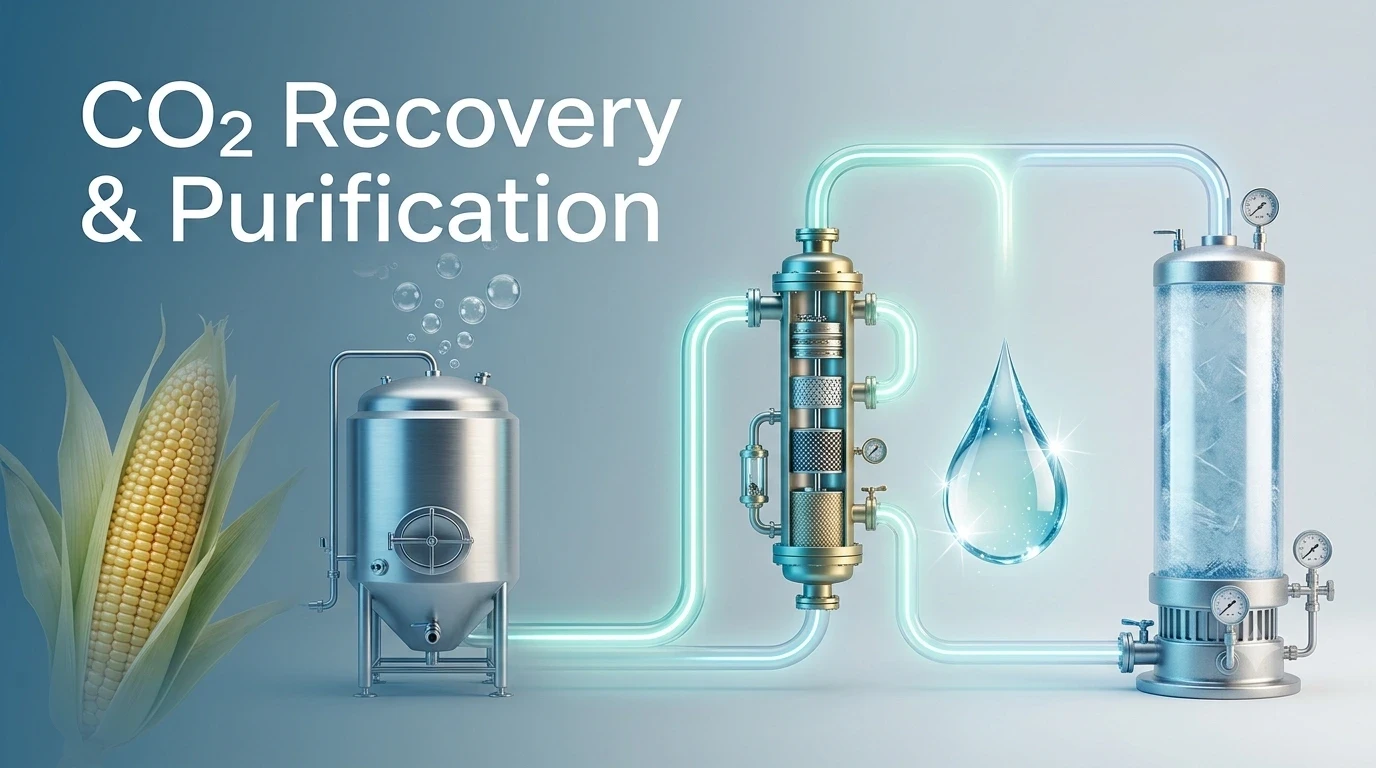
Ethanol production generates more than just fuel. During fermentation, yeast converts sugars into ethanol and carbon dioxide (CO₂). Instead of releasing this gas into the atmosphere, ethanol plants can capture it, purify it and convert it into liquid CO₂ for commercial use.
Recovered CO₂ is used in carbonated beverages, food processing, dry ice manufacturing, water treatment, MIG welding, and various industrial applications. However, its suitability for these uses depends heavily on effective purification, moisture removal, and strict quality control.
In this guide, we explain how CO₂ is recovered from ethanol fermentation, the key purification stages, and how quality is maintained for different industrial and food-related applications.
During fermentation, yeast converts glucose into ethanol and carbon dioxide:
C₆H₁₂O₆ → 2 C₂H₅OH + 2 CO₂
The process produces approximately 0.96 kg of CO₂ for every kilogram of ethanol, based on the theoretical reaction. Actual recovery depends on fermentation efficiency, operating conditions and collection parameters.
Fermentation gas is particularly suitable for CO₂ recovery because it contains a high CO₂ concentration (>98%) compared to fossil-fuel combustion off-gases. However, raw fermentation gas also carries moisture, alcohol vapors, aldehydes, and trace volatile organic compounds (VOCs) that must be systematically extracted before commercial distribution.
Recovering this gas allows ethanol producers to convert a by-product into a valuable resource while supporting circular, zero-waste operations.
The exact equipment and operating conditions vary between plants, but a typical CO₂ recovery system involves the following stages.
During fermentation, yeast releases CO₂ continuously. The gas is captured directly from fermentation tanks through a dedicated piping system and directed to the recovery unit.
Maintaining positive pressure prevents ambient air ingress, keeping nitrogen and oxygen levels minimal.
The collected gas is passed through a water scrubber where counter-current water washes out entrained particles and water-soluble compounds like ethanol vapor.
Cooling the gas condenses excess moisture, and recovered ethanol streams are piped back to the distillation section to maximize ethanol yields.
Once washed, the CO₂ gas enters multi-stage compressors to increase pressure to operational levels required for filtration and cryogenic liquefaction (18 - 22 bar). Oil-free compressors or food-grade lubrication systems are utilized to prevent secondary hydrocarbon contamination.
Equipment selection, lubrication arrangements and maintenance practices are especially important when producing CO₂ intended for food and beverage applications.
Raw fermentation CO₂ can contain trace contaminants such as aldehydes, volatile organic compounds and sulphur compounds. Even at low concentrations, certain impurities can affect the gas's odour, taste or suitability for its intended application.
To eliminate these, the gas stream passes through:
The treatment system must be selected according to the impurities present. Monitoring and timely replacement or regeneration of purification media help maintain consistent performance.
Moisture must be reduced before the gas enters the cold sections of the recovery system. Excess water can freeze during cooling and liquefaction, potentially obstructing equipment and affecting reliable operation.
CO₂ is typically passed through twin-tower desiccant dryers packed with molecular sieves, reducing the moisture dew point below -50°C (≤ 20 ppm H2O).
Once purified and dried, the compressed CO₂ is cooled using a refrigeration system until it condenses into clear liquid CO₂ under suitable pressure and temperature conditions (-20°C to -25°C).
Liquefaction shrinks the chemical volume significantly, allowing efficient bulk transport.
Liquid CO₂ may contain dissolved non-condensable gases, including oxygen, nitrogen and hydrogen. A stripping or distillation column separates these non-condensable gases from the liquid phase, driving final purity to 99.9% or higher.
After purification, liquid CO₂ is transferred to suitable insulated pressure vessels designed to maintain the required storage conditions.
Storage tanks, transfer lines, valves and loading equipment must be maintained and handled properly to prevent contamination. Documented cleaning procedures, equipment inspections and controlled loading practices help preserve product quality during delivery.
Both food-grade and industrial-grade CO₂ can be produced through recovery and purification, but their specifications depend on the intended application.
Parameter |
Food and Beverage CO₂ |
Industrial CO₂ |
|---|---|---|
| Purity Level | 99.9% or higher | 99.0% - 99.5% |
| Primary Concern | Taste, odor neutrality, human safety | Process performance, oxidation prevention |
| Compliance Standard | IS 307 / IS 16422 / FSSAI Guidelines | Industrial buyer specifications |
| Impurity Thresholds | Strict limits on benzene, sulphur compounds, VOCs, moisture | Less stringent; depends on operational use |
| Quality Testing | In-line Gas Chromatography (GC) & batch recording | Routine physical and purity checks |
| Common Uses | Beverage carbonation, MAP packaging, dry ice | Shielding gas welding, pH neutralization, chemical synthesis |
Important: A 99.9% overall purity metric alone does not make CO₂ food-grade. Specific trace contaminants, food safety standards (such as FSSAI certification), dedicated handling equipment, and documented batch testing must all be verified.
Producing reliable liquid CO₂ requires continuous analytical oversight across every manufacturing shift:
Producing high-quality CO₂ requires more than capturing fermentation gas. Each stage, from collection and purification to liquefaction, storage and testing, contributes to the final product's consistency and suitability.
At Edhas Biofuel, our advanced grain-based bio-refinery in Gujarat integrates modern CO₂ recovery and purification systems. We deliver certified, high-purity liquid CO₂ tailored to strict industrial and food-grade specifications.
CO₂ is recovered by collecting the gas released during fermentation and passing it through treatment stages such as washing, compression, impurity removal, drying, liquefaction and final purification. The purified CO₂ is then stored in suitable pressure vessels for transportation and commercial use.
CO₂ intended for food and beverage applications undergoes purification to remove moisture, oxygen, sulphur compounds, volatile organic compounds and other relevant contaminants. Techniques such as activated carbon adsorption, drying and distillation may be used. Laboratory testing and compliance with applicable food-grade specifications help verify its suitability.
Food-grade CO₂ must meet applicable food and beverage requirements, including limits for specific contaminants, while industrial-grade CO₂ must meet the requirements of its intended industrial application. Overall purity alone does not determine whether CO₂ is suitable for food use; impurity limits, testing and handling practices are also important.
CO₂ recovery converts a by-product of ethanol fermentation into a commercially valuable resource. It can create an additional revenue stream for ethanol producers and supply industries such as beverage manufacturing, food processing, dry ice production and water treatment. It can also improve resource utilisation and support more efficient use of biomass-derived feedstock.
Bio-CO2 comes from fermentation of plant-based feedstock. It starts at high concentration and low contamination, so it generally needs less energy to purify than CO2 captured from combustion exhaust.

Get the latest updates on renewable energy, sustainability trends, and our initiatives delivered straight to your inbox.