
Subscribe to Our Newsletter
Join our community and stay updated.

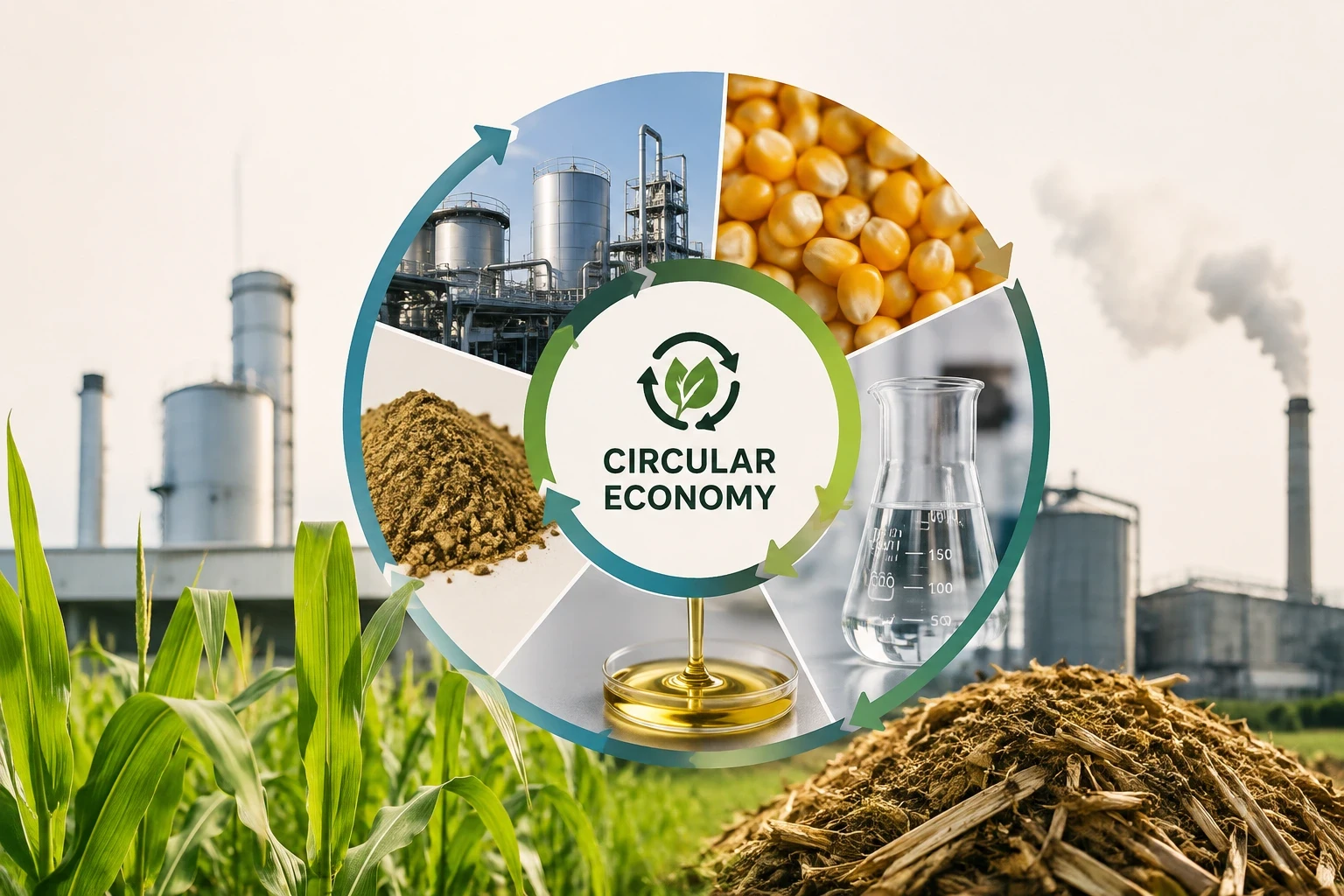
India's ethanol industry is usually discussed in terms of petrol blending and reducing dependence on imported crude oil. But ethanol production has another important aspect: the same agricultural feedstock can generate several useful products instead of being used for fuel alone.
In grain-based ethanol production, for example, starch is converted into ethanol while other components of the grain can be recovered as DDGS and maize oil. Carbon dioxide produced during fermentation can also be captured for industrial applications.
India has already reached an average ethanol blending level of 20% in the 2025–26 Ethanol Supply Year. Ethanol production capacity has also grown from about 421 crore litres in 2014 to around 2,000 crore litres in 2026.
This broader use of agricultural resources is one way ethanol production can contribute to India's circular economy.
A circular economy focuses on keeping resources in use for as long as possible and finding productive uses for materials that would otherwise be discarded.
In a conventional production model, raw materials are converted into a product and the remaining material may become waste. A circular approach looks at whether those remaining materials can be recovered, reused or converted into another useful product.
For the biofuel industry, this can mean getting more value from agricultural feedstocks and using different parts of the same resource across multiple applications.
Grain-based ethanol production provides a simple example.
Maize contains starch, protein, fibre, oil and other components. The starch is the main component used to produce ethanol. During processing, other components can be recovered and used separately.
The overall process can therefore be viewed as:
Agricultural feedstock → Ethanol + DDGS + Maize Oil + CO₂
These products serve different markets and applications.
This is different from treating the feedstock as something that produces only one final product.
In a grain-based ethanol plant, grains such as maize are cleaned and milled before the starch is converted into fermentable sugars.
Yeast then ferments these sugars to produce ethanol and carbon dioxide. The fermented material goes through distillation and dehydration to produce fuel-grade ethanol.
The non-fermented components of the grain remain in the process and can be recovered as co-products.
The efficiency of the plant therefore depends not only on ethanol production but also on how effectively these other materials are recovered and utilized.
Distillers Dried Grains with Solubles (DDGS) is one of the main co-products of grain-based ethanol production.
During ethanol production, much of the starch in the grain is converted into ethanol. Other components, including protein, fibre and minerals, remain in the material that is recovered as DDGS.
DDGS can be used as an ingredient in animal feed, including cattle and poultry feed, depending on its nutritional composition and the requirements of the feed formulation.
This creates another use for the original grain:
Maize → Ethanol
and
Maize → DDGS → Animal Feed
As India's ethanol production expands, the availability and use of DDGS also become relevant to the country's animal-feed sector.
Maize also contains oil, which can be recovered during grain ethanol production.
The resulting maize oil can have applications in animal feed and industrial processing, depending on its quality and specifications.
This means that different components of the same grain can serve different markets.
For an ethanol plant, recovering these components can improve overall resource utilization while creating additional products alongside ethanol.
Carbon dioxide is naturally produced during the fermentation stage of ethanol manufacturing.
Instead of releasing all of this CO₂, ethanol plants can capture, purify and supply it for suitable industrial applications. Recovered CO₂ can be used in areas such as food and beverage processing, refrigeration and other industrial processes, depending on its purity and intended use.
This creates another potential output from the ethanol production process:
Fermentation → CO₂ → Industrial Applications
CO₂ recovery requires suitable equipment and purification systems, so its feasibility depends on the individual plant and market demand. Where it is commercially viable, it allows another material from the production process to be put to use.
The connection between ethanol and the circular economy also extends beyond the ethanol plant.
Grain-based ethanol production creates demand for agricultural feedstocks, particularly maize. This provides an additional market for farmers and connects agricultural production with the fuel industry.
India's ethanol programme has expanded significantly over the past decade. According to the Government of India, the country achieved an average ethanol blending level of 20% in the 2025–26 Ethanol Supply Year. Ethanol production capacity has also increased substantially compared with 2014.
The government has also reported increased farmer earnings associated with the ethanol programme, along with savings in foreign exchange from reduced crude-oil consumption.
This creates a broader chain:
Farmers → Agricultural Feedstock → Ethanol Plants → Fuel + Co-products → Different Industries
The circular-economy potential of biofuels is not limited to grains.
2G ethanol uses lignocellulosic biomass such as agricultural residues. Instead of relying primarily on starch or sugar, 2G technology can process cellulose and hemicellulose from plant material into fermentable sugars, which can then be converted into ethanol.
This creates another opportunity to use agricultural residues as a resource.
For a country with a large agricultural sector, finding productive uses for crop residues can be important. India's biofuel policy has therefore also encouraged the development of advanced biofuel projects using agricultural residues and other eligible feedstocks.
2G ethanol is still a different production route from conventional grain-based ethanol, but both contribute to the broader development of India's biofuel industry.
The primary product remains ethanol itself.
Blending ethanol with petrol allows a portion of India's transportation-fuel requirement to be met through domestically produced ethanol. This can reduce the amount of petrol required from petroleum-based sources.
The Government of India has reported that the ethanol blending programme has resulted in substantial crude-oil substitution and foreign-exchange savings since its expansion.
This is an important part of the circular-economy discussion because agricultural resources are being connected to the country's energy requirements.
However, ethanol should not be viewed as a complete replacement for petroleum. Its role is to provide a renewable component within India's wider fuel system.
One of the strongest connections between ethanol production and resource efficiency is the use of co-products.
A grain ethanol plant can potentially create value from several parts of the feedstock:
Input or Output |
Potential Use |
|---|---|
| Starch | Ethanol |
| Protein & fibre | DDGS / animal feed |
| Maize oil | Feed and industrial applications |
| Fermentation CO₂ | Industrial applications |
| Agricultural residues | 2G ethanol |
The actual products and recovery rates depend on the technology and design of the ethanol plant. Market demand and product quality also determine whether a particular co-product can be commercially utilized.
Still, the principle remains useful: the more components of a feedstock that can be put to productive use, the less material is left without a purpose.
India's ethanol industry has grown from a relatively small blending programme into a major part of the country's fuel and agricultural economy.
As production continues to develop, attention is likely to remain on more than just ethanol volumes. Efficient feedstock use, co-product recovery, agricultural supply chains and the development of technologies such as 2G ethanol will also influence how the industry develops.
For grain-based ethanol in particular, the connection is straightforward:
Agricultural feedstock is processed into ethanol, while other components can be recovered and supplied to different industries.
That does not make ethanol production completely waste-free or automatically sustainable. The overall impact depends on factors such as feedstock sourcing, energy and water use, production efficiency, transportation and how effectively co-products are utilized.
But when these factors are managed properly, ethanol production can contribute to a system in which agricultural resources are used across more than one market.
India's ethanol industry is playing a growing role in the country's fuel sector, but its contribution goes beyond petrol blending.
Grain-based ethanol production can connect agriculture with fuel, animal feed, industrial oil and CO₂ markets. The development of 2G ethanol also creates opportunities to use agricultural residues that have traditionally had fewer high-value applications.
For Edhas Biofuel, this broader perspective is important. Ethanol is not simply about converting a feedstock into fuel. It is also about making practical use of the different materials generated during the process and connecting them with industries that can use them.
That is where ethanol production can play a meaningful role in India's move toward a more resource-efficient circular economy.
Ethanol production can support a circular economy by using agricultural feedstocks to produce fuel while also recovering useful co-products such as DDGS, maize oil and CO₂ for different applications.
The main co-products of grain-based ethanol production include DDGS, maize oil and carbon dioxide. Their uses range from animal feed and industrial applications to CO₂ recovery for suitable commercial uses.
DDGS is a co-product of grain-based ethanol production. After starch is converted into ethanol, the remaining protein, fibre and other components can be processed into DDGS, which is used as an animal-feed ingredient.
Yes. Carbon dioxide generated during fermentation can be captured, purified and supplied for suitable industrial applications, depending on its purity and the requirements of the end use.
Ethanol production creates additional demand for agricultural feedstocks such as maize, connecting farmers and agricultural supply chains with the fuel industry. India's ethanol programme has also been associated with increased farmer earnings.
2G ethanol can use agricultural residues and other lignocellulosic biomass as feedstock. This provides another way to utilize plant material that may otherwise have limited economic use and convert it into ethanol.

Get the latest updates on renewable energy, sustainability trends, and our initiatives delivered straight to your inbox.