
Subscribe to Our Newsletter
Join our community and stay updated.

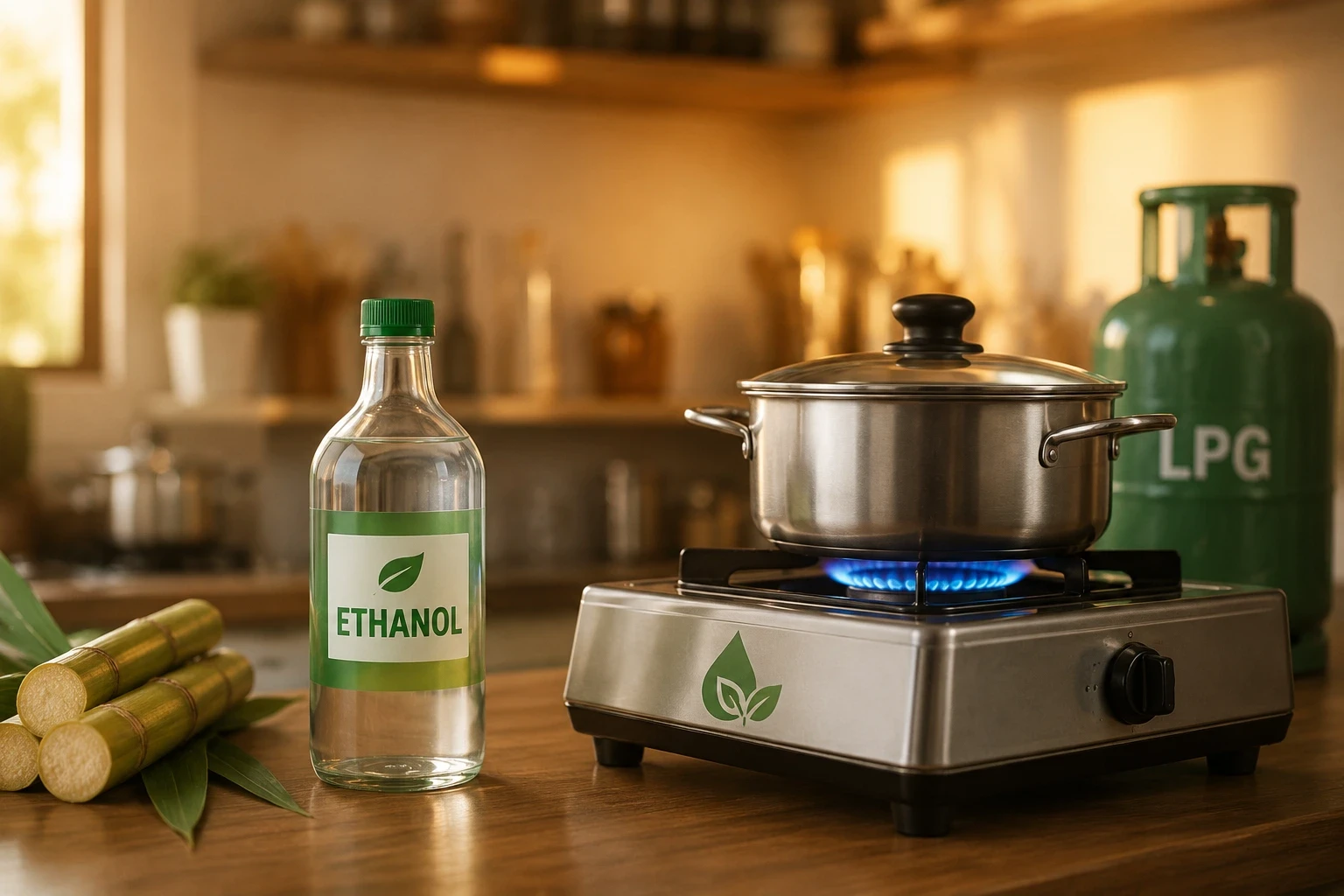
India's kitchens have run on the same fuel story for decades: LPG cylinders, imported largely from the Gulf and supported by one of the world's largest subsidy programmes. That story may now be entering a new chapter. The Ministry of Petroleum and Natural Gas is drafting a first-of-its-kind policy framework to introduce ethanol as a mainstream household cooking fuel, positioning it alongside LPG rather than as a direct replacement.
For an ethanol industry that has already transformed India's transport fuel mix through E20 blending, this represents a genuinely new frontier, one that could convert surplus production into a second major demand channel, this time in the kitchen rather than the fuel tank.
Three factors have converged to bring ethanol cooking fuel onto the government's agenda.
India's rapid rollout of E20 petrol pushed production capacity beyond 20 billion litres a year. With blending targets largely achieved, distilleries now have more production capacity than the transport fuel market can absorb, leaving an estimated 7 billion litres annually seeking new demand.
India remains one of the world's largest LPG consumers, with a significant share imported from Gulf producers through the Strait of Hormuz. Recent disruptions in West Asia highlighted the risks of this dependence, prompting oil marketing companies to expand strategic LPG reserves while the government explored domestically produced alternatives.
LPG subsidies represent a long-term fiscal commitment. Industry estimates suggest that shifting a meaningful share of households towards alternative cooking fuels could save the exchequer more than ₹2 lakh crore in cumulative subsidy costs by 2050, an amount significant enough to warrant serious policy attention.
While details are still being finalized, the reported framework includes the following:
Element |
What's Being Considered |
|---|---|
| Positioning | Ethanol as a companion fuel to LPG, not an immediate replacement |
| Target timeline | Draft policy expected by September 2026 |
| Distribution model | "Ethanol ATM" refill kiosks at existing fuel retail outlets, avoiding the need for a new distribution network |
| Stove technology | State-run oil marketing companies and private manufacturers are field-testing dedicated ethanol stoves and burner designs |
| Subsidy approach | Government is evaluating a one-time capital subsidy for stoves, an ongoing fuel subsidy, or a combination of both |
| Export angle | Surplus ethanol could also be supplied to neighbouring markets such as Nepal, Bangladesh, and Indonesia, where blending programmes are expanding faster than domestic production |
Oil marketing companies such as Indian Oil, BPCL, and HPCL are expected to play a central role, leveraging their existing retail networks while creating a new revenue stream beyond petrol and diesel sales.
This is where policy ambitions meet practical reality.
If the framework progresses from policy to implementation, it could create an entirely new demand category that complements rather than competes with transport fuel blending or emerging markets such as sustainable aviation fuel (SAF).
Several questions will determine whether ethanol cooking fuel becomes a mainstream market or remains a limited pilot.
Ethanol cooking fuel is unlikely to replace LPG anytime soon, and the government itself is positioning it as a complementary option rather than a substitute. Even so, the direction is clear. India's ethanol industry, built primarily around transport fuel over the past decade, is now being considered for a second strategic role, strengthening energy security in households as well as at the pump.
For producers with underutilized capacity, that is an important signal. The same distilleries and feedstock economics that supported the rise of E20 could soon serve an entirely new market. For integrated ethanol manufacturers such as Edhas Biofuel, emerging demand from household cooking applications could provide another avenue for long-term growth alongside transport fuel blending, provided the policy framework translates into commercial adoption. Companies that closely monitor stove technology, policy developments, and oil marketing company distribution plans will be best positioned to capitalize if this market moves from concept to commercial reality.
The Ministry of Petroleum and Natural Gas is drafting a policy framework to introduce ethanol as a household cooking fuel alongside LPG, using India's surplus ethanol production capacity. The framework is targeted for finalization by September 2026.
Not immediately. The policy positions ethanol as a companion fuel to LPG rather than a full replacement, with adoption expected to scale gradually as stove technology and distribution infrastructure develop.
The move is driven by a growing ethanol surplus following the success of the E20 blending programme, concerns over LPG import dependence on Gulf supply routes, and the potential to reduce India's long-term LPG subsidy bill.
Industry executives suggest "ethanol ATM" style refill points at existing fuel retail outlets are among the models being evaluated, allowing oil marketing companies to use their current network instead of building new infrastructure.
Ethanol has a lower calorific value than LPG, so more fuel is needed by volume for the same cooking output. Whether it's cost-competitive per meal depends heavily on stove design and burn efficiency, which is currently being field-tested.

Get the latest updates on renewable energy, sustainability trends, and our initiatives delivered straight to your inbox.