
Subscribe to Our Newsletter
Join our community and stay updated.

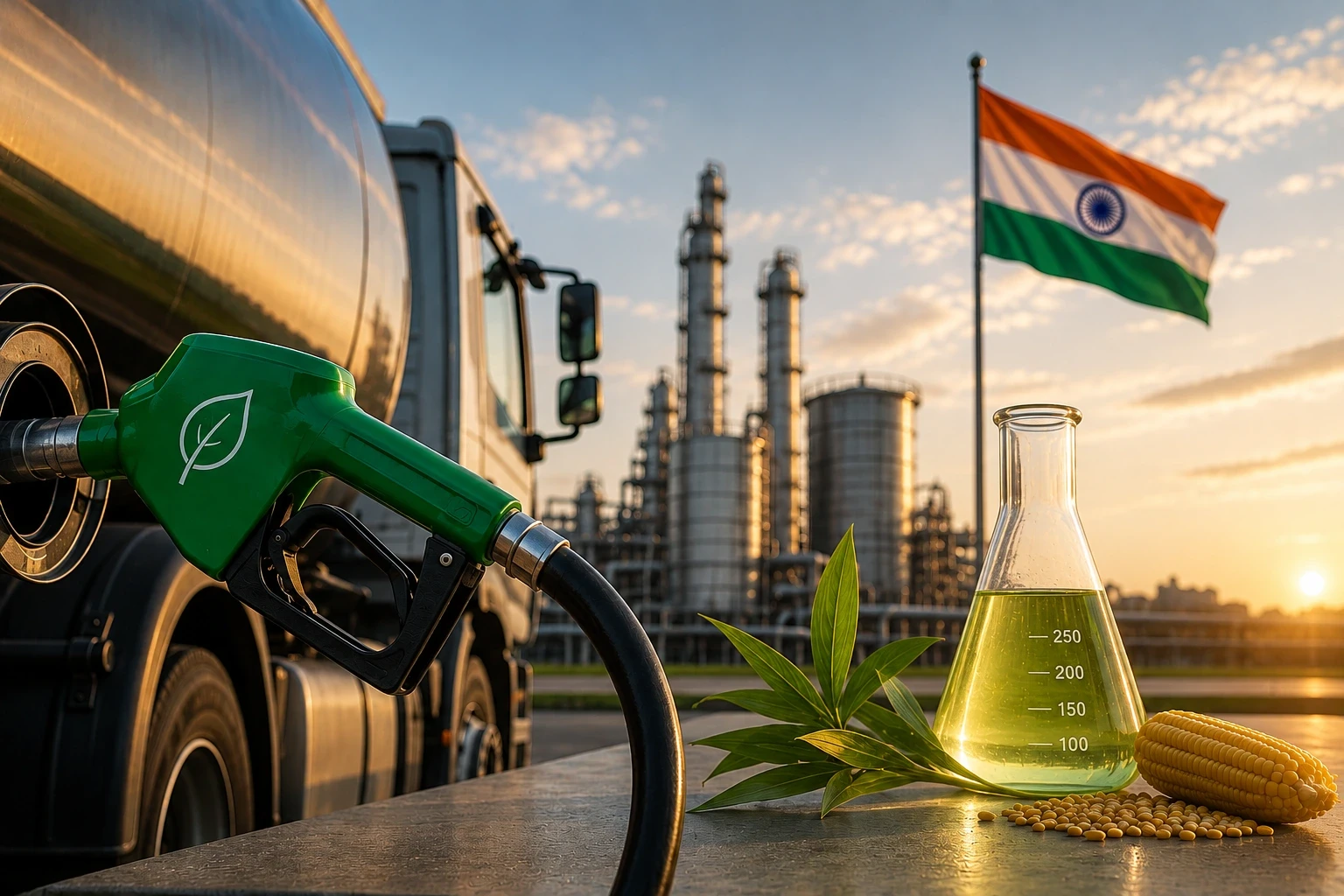
India achieved its E20 blending target ahead of schedule in mid-2025. That's a genuine achievement, one that took nearly a decade of policy work, distillery investments, and supply chain building to pull off.
But success has created a new challenge: surplus ethanol capacity.
India's ethanol production capacity has expanded from less than 2 billion litres in 2014 to nearly 20 billion litres by late 2025. Yet E20 blending requires only around 11 billion litres annually. That's a significant gap, and the industry is now looking to find new outlets for the surplus.
The idea gaining the most attention? Blending ethanol with diesel.
But is it technically feasible? And more importantly, can it realistically absorb India's growing ethanol surplus?
Let's understand it clearly.
Petrol is a relatively small part of India's fuel market. Diesel is where the real volume is.
Fuel |
Share of India's Consumption |
|---|---|
| Diesel | ~40% |
| Petrol | ~15–18% |
Diesel powers trucks, tractors, buses, railways, agricultural equipment, construction machinery.
If ethanol could be blended into diesel, even at a modest 5–10%, it could create demand far greater than E20 in petrol.
This is what the All India Distillers' Association (AIDA) has been pushing for. At a February 2026 roundtable titled "What Lies Beyond E20?", AIDA brought together distillers, technology companies, and policy stakeholders to make the case.
Their argument: Diesel blending can absorb the surplus, reduce crude oil imports further, and give the ethanol programme a longer runway.
It's a logical case on paper. The challenge is that the chemistry doesn't agree.
Ethanol works well in petrol engines because both fuels ignite through a spark. Diesel engines work differently. They use compression ignition, which requires fuels with a high cetane number for reliable combustion.
Property |
Ethanol |
Diesel |
|---|---|---|
| Ignition method | Spark | Compression |
| Cetane number | Low | High |
| Combustion reliability | Poor in diesel engines | Excellent |
Because ethanol has a low cetane number, it doesn't ignite reliably under compression.
This leads to:
These are fundamental fuel characteristics, not issues that can be solved through minor engine adjustments.
India has already experimented with direct ethanol-diesel blending.
During the India Sugar & Bio-Energy Conference in 2025, Union Minister Nitin Gadkari confirmed that earlier trials did not produce satisfactory results. Technical limitations and performance concerns prevented further progress.
As a result, researchers have started exploring alternatives rather than pursuing direct ethanol blending.
Rather than shelving the idea entirely, the Automotive Research Association of India (ARAI) has shifted focus to isobutanol.
Unlike ethanol, isobutanol offers better combustion characteristics for diesel applications.
| Factor | Ethanol | Isobutanol |
|---|---|---|
| Cetane number | Low | Higher |
| Compatibility with diesel engines | Poor | Better |
| Production complexity | Lower | Higher |
ARAI is currently running trials on a 10% isobutanol-diesel blend to see whether it holds up under real-world Indian conditions.
While this makes isobutanol a more promising candidate, there is an important distinction: Isobutanol is not ethanol.
Even if ongoing trials are successful, the demand created would be for isobutanol rather than the surplus ethanol currently available at Indian distilleries.
Additionally, large-scale adoption would require:
None of that happens quickly.
Diesel blending is unlikely to be a near-term outlet for ethanol. The technical barriers are real, the regulatory process is slow, and the pivot to isobutanol means the pathway looks different from what AIDA originally proposed.
That said, the conversation around "what comes after E20" is genuinely useful. It's forcing a look at alternative demand channels that haven't been explored seriously before.
AIDA has already proposed raising ethanol blending targets from 20% to 30%.
Why E30 makes sense:
For ethanol producers, E30 remains the most straightforward way to absorb surplus ethanol production.
India imports large volumes of LPG for domestic cooking. The government is evaluating ethanol stoves as an alternative, particularly in rural markets.
SAF is emerging as one of the most promising long-term biofuel opportunities.
India has announced SAF blending ambitions for international flights and ethanol is among the feedstocks being explored for aviation fuel production.
While commercial scale may still be years away, growing global demand for low-carbon aviation fuels makes SAF an area worth watching closely.
Opportunity |
Timeline |
Viability for Ethanol Producers |
|---|---|---|
| Ethanol-Diesel Blending | 3+ years | Low (not ethanol-compatible) |
| E30 Petrol Blending | 1–2 years | High |
| Ethanol Cooking Fuel | 2–4 years | Medium (depends on policy) |
| Sustainable Aviation Fuel | 5+ years | Medium to High |
Ethanol-diesel blending is a real idea being seriously discussed at the policy level. But based on where the science and trials stand today, it is not something that will create meaningful demand for ethanol producers in the next two to three years.
The more immediate opportunity is E30, and the more interesting long-term one is probably SAF.
India's ethanol programme has shown it can move fast when policy, technology, and economics line up. For diesel blending, those three things are not yet aligned.
Distilleries that built capacity for E20 should:
The next phase of growth is likely to come from a combination of policy expansion and product diversification rather than diesel blending alone.
Ethanol-diesel blending continues to attract attention because of diesel's massive share in India's fuel consumption. However, current technical limitations and ongoing research suggest that it is unlikely to become a significant demand driver for ethanol producers in the near term.
For now, the more practical opportunities lie in the expansion of E30 petrol blending, the development of ethanol-based cooking fuel applications, and the long-term growth potential of Sustainable Aviation Fuel (SAF). These pathways are better aligned with existing infrastructure, policy momentum, and market readiness.
At Edhas Biofuel Refinery, we see this transition as a natural evolution of India's biofuel journey. As a grain-based ethanol producer in Gujarat, our focus extends beyond meeting today's demand. We continuously monitor emerging opportunities across the biofuel ecosystem while strengthening our capabilities in ethanol, DDGS, maize oil, CO₂, and biomass production.
The success of E20 has demonstrated what is possible when policy, technology, and industry work together. The next phase of growth will require the same collaborative approach. Producers that stay informed, adapt early, and invest in future-ready opportunities will be best positioned to thrive in India's evolving biofuel landscape.
While the idea is being explored, direct ethanol-diesel blending faces significant technical challenges. Ethanol has a low cetane number, making it unsuitable for conventional diesel engines without modifications.
India has rapidly expanded its ethanol production capacity, creating concerns about surplus supply. Since diesel accounts for a much larger share of fuel consumption than petrol, blending biofuels with diesel could create a substantial new demand channel.
Isobutanol is an alcohol-based biofuel with better combustion characteristics for diesel engines than ethanol. The Automotive Research Association of India (ARAI) is currently evaluating isobutanol-diesel blends as a potential alternative.
Many industry experts consider E30 petrol blending the most practical next step. It can leverage existing ethanol production capacity and fuel distribution infrastructure while creating additional demand for ethanol.
Ethanol is one of the feedstocks being evaluated for Sustainable Aviation Fuel production. As India and global aviation markets increase SAF adoption, it could become a significant long-term growth opportunity for ethanol producers.

Get the latest updates on renewable energy, sustainability trends, and our initiatives delivered straight to your inbox.