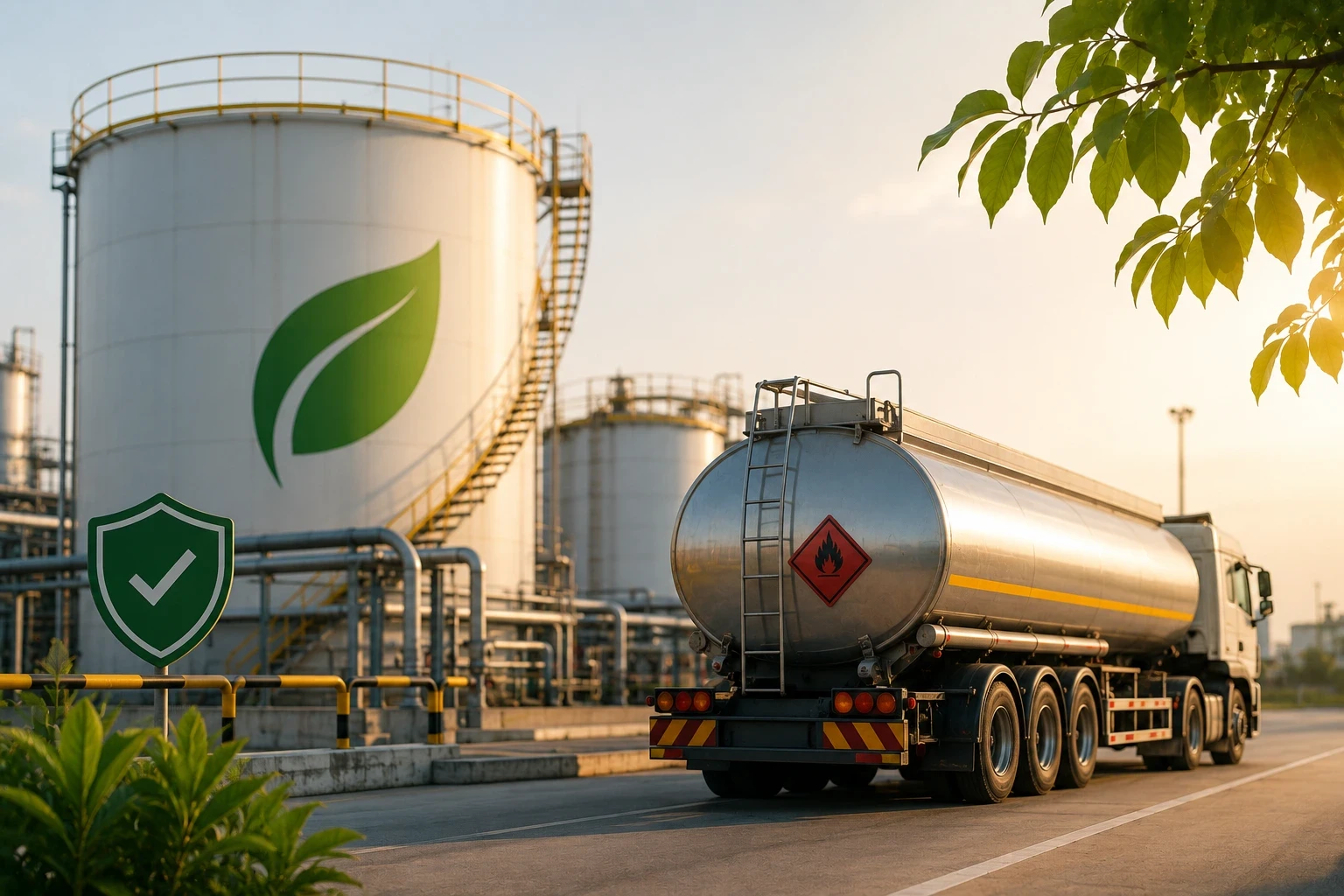
ethanol-storage-handling-transport-safety-compliance-india

Ethanol Storage, Handling, and Transport: Safety Guidelines & Compliance in India

India's Ethanol Blended Petrol (EBP) Programme has moved the country from single-digit blending to a nationwide 20% ethanol blend (E20) with E85 and E100 already on the roadmap. That growth means one thing for every distillery and biofuel supplier: millions of litres of high-purity fuel ethanol now have to move safely from fermentation tank to petrol pump.

Because anhydrous ethanol (99.5%+ purity) is volatile, hygroscopic, and highly flammable, it is classified under Indian law as a Class A Petroleum product. Ensuring absolute safety during bulk storage, handling, denaturation, and highway transportation is not merely a legal checkbox, it is a vital pillar for sustainable, zero-incident operations. 

Below is a comprehensive guide to the safety guidelines, material compatibility rules, and regulatory frameworks governing ethanol logistics in India.

Key Takeaways

  • Fuel ethanol in India is regulated by four separate bodies: PESO, OISD, State Excise, and CPCB/SPCB, each covering a different part of the chain.
  • Storage tanks need internal floating roofs or nitrogen blanketing, plus bund walls sized to 110% of tank capacity.
  • Ethanol must be denatured on-site before it ever leaves the distillery, to prevent diversion into the beverage market.
  • Ethanol attacks certain metals and elastomers (zinc, aluminium, natural rubber), material selection is a genuine safety issue, not just an engineering preference.
  • Ethanol fires burn with an almost invisible flame and produce no smoke, which means standard firefighting and detection equipment doesn't work, plants need alcohol-resistant foam and UV/IR flame detectors.
  • Road transport requires PESO-licensed tankers, Hazchem/UN 1170 labelling, spark arrestors, and driver TREM Card certification.

Regulatory Framework Governing Ethanol in India

Industrial and fuel-grade ethanol operations in India fall under multi-agency regulatory oversight. Any facility manufacturing, storing, or transporting ethanol must comply with guidelines established by the following authorities:

Regulatory Body

Governing Act / Standard

Core Mandate

PESO (Petroleum and Explosives Safety Organisation) The Petroleum Act, 1934 & Petroleum Rules, 2002 Storage licenses, layout approvals, tank construction sign-off, tank truck clearances
OISD (Oil Industry Safety Directorate) OISD-STD-117, OISD-STD-244, OISD-STD-105 Fire protection standards, inter-tank safety distances, static grounding, pump house layout
State Excise Department Respective State Excise Acts & Denaturation Rules Movement permits (NOCs), denaturation supervision, prevention of diversion to the beverage industry
CPCB / SPCB Environment Protection Act, Air & Water Acts Vapour-loss control, spill containment, secondary dykes, Zero Liquid Discharge (ZLD) norms

Safe Bulk Storage Guidelines for Fuel Ethanol

Ethanol has a closed-cup flash point of approximately 13°C (55.4°F), placing it firmly in Flammable Liquid Category 2. Storing high volumes requires rigorous engineering controls to avoid vapor accumulation, static buildup, or accidental ignition.

1. Tank Engineering & Design Standards

  • Internal Floating Roof Tanks (IFR): Aboveground vertical cylindrical steel tanks fitted with Internal Floating Roofs are preferred. A floating roof sits directly on the liquid surface, effectively eliminating the vapour space inside the tank and sharply cutting both evaporative losses and explosion risk.
  • Nitrogen Blanketing: For fixed-roof storage tanks, an automated inert nitrogen blanketing system must be installed to maintain an oxygen-deficient atmosphere above the liquid surface.
  • Containment Dykes (Bund Walls): Storage tanks must be located inside leak-proof bunded enclosures capable of containing at least 110% of the capacity of the largest single tank within the enclosure.

2. Venting, Earthing, and Static Control

Ethanol generates static electricity as it flows, so grounding is treated as a primary safeguard, not a formality:

  • Pressure-Vacuum Relief Valves (PVRV): Tanks require PVRVs coupled with ISO 16852-certified flame arrestors to relieve pressure from thermal expansion/contraction while preventing any external flame from reaching the tank interior.
  • Grid Grounding: All storage tanks, piping manifolds, and loading racks must be cross-bonded and connected to a dedicated grounding earth grid with an earth resistance below 10 Ohms.

Denaturation Protocol & Material Compatibility

Denaturation Rules

To satisfy State Excise requirements and eliminate the risk of illegal diversion into the beverage sector, anhydrous ethanol must be denatured inside the distillery premises before leaving the facility.

  • Approved Denaturants: As per Oil Marketing Company (OMC) and Excise standards, ethanol is typically denatured with 0.2% to 0.5% Motor Spirit (Gasoline) v/v or specific bittering chemicals like Crotonaldehyde or Denatonium Benzoate (Bitrex).

Material Compatibility Matrix

  • Ethanol is a strong solvent and mild electrolyte that can attack certain metals, polymers, and elastomers, causing leaks or chemical degradation.

Category

Compatible

Avoid

Metals Stainless Steel (SS304, SS316), Carbon Steel Galvanized Steel, Zinc, Aluminium, Copper, Brass
Elastomers & Seals PTFE (Teflon), Viton (FKM), Kalrez, EPDM Natural Rubber, Neoprene, Buna-N (Nitrile)
Piping & Valves Class 150/300 SS Flanged Globe/Ball Valves PVC, Plastic, Threaded Cast Iron Fittings

Using an incompatible material isn't a minor spec miss, it's a direct path to seal failure and leaks over time.

Transportation Guidelines & Tank Truck Logistics

Ethanol travels from grain distilleries to OMC terminal depots by road tanker, governed by the Central Motor Vehicles Rules (CMVR) alongside PESO's transport guidelines.

Mandatory Road Tanker Protocols

  • PESO Licensing: Every tanker must hold a valid PESO certificate specifically endorsing the vehicle for Class A Petroleum carriage.
  • Hazchem Marking & Signage: Tankers must display UN 1170 number (Ethanol / Ethyl Alcohol solution), Hazchem Code 2YE or 3WE, and the Class 3 Flammable Liquid (Flammable Flame Symbol) hazard label.
  • Bottom Loading & Vapor Recovery (VRS): Modern supply terminals require bottom loading gantries with dry-disconnect couplings and secondary vapor-recovery hoses to collect escaping vapors back into the depot recovery system.
  • Exhaust Spark Arrestors: Vehicle exhaust pipes must be routed to the front below the bumper and fitted with a PESO-certified spark arrestor.
  • TREM Card & Driver Certification: Drivers must carry a Transport Emergency Card (TREM Card) outlining emergency steps during spills or crashes, and possess valid CMVR Rule 9 Hazardous Goods Driving Certification.
  • Telematics & Speed Governors: Transporters must equip vehicles with GPS tracking systems and speed governors set to a maximum of 60 km/h.

Fire Protection & Emergency Response Measures

Ethanol fires behave differently from petroleum fires in ways that catch under-prepared facilities off guard: the flame burns pale blue and is nearly invisible in daylight, with almost no smoke.

  • Alcohol-Resistant Foams (AR-AFFF): Standard firefighting foams breakdown when contact is made with polar solvents like ethanol. Alcohol-Resistant Aqueous Film-Forming Foam (AR-AFFF) forms a protective polymeric membrane over the liquid surface to smother the fire.
  • Optical Flame Detectors: Standard optical smoke detectors fail to detect clean ethanol combustion. Facilities must install Triple-Spectrum Ultraviolet/Infrared (UV/IR) Flame Detectors.
  • Deluge Water Sprinklers: Storage tanks must feature automated water spray deluge rings to keep tank shells cool if exposed to heat from adjacent fires.

Best Practices for Safe Ethanol Operations

At Edhas Biofuel, safety, compliance, and product purity are built into every stage of our operations from grain processing and fermentation to automated loading and fleet dispatch. By strictly observing PESO norms, OISD standards, and rigorous material compatibility checks, we deliver reliable, high-purity fuel ethanol to support India's green energy transformation, from our Gujarat manufacturing base outward.

Frequently Asked Questions (FAQs)

Why is ethanol classified as a Class A Petroleum product in India?

Ethanol is classified as a Class A Petroleum product under the Petroleum Act, 1934 because anhydrous fuel ethanol has a flash point of around 13°C, making it highly flammable and subject to strict storage and transport regulation.

Which authority regulates ethanol storage in India?

PESO (the Petroleum and Explosives Safety Organisation) regulates ethanol storage in India, issuing storage licenses, layout approvals, and tank construction clearances under the Petroleum Rules, 2002.

Why must ethanol be denatured before it leaves a distillery?

Ethanol must be denatured on-site typically with 0.2–0.5% Motor Spirit or a bittering agent like Bitrex because State Excise rules require it to prevent fuel-grade ethanol from being diverted into the potable alcohol market.

Can regular firefighting foam extinguish an ethanol fire?

No, regular firefighting foam cannot extinguish an ethanol fire because standard foam breaks down on contact with polar solvents; facilities must use Alcohol-Resistant AFFF (AR-AFFF), which forms a protective film to smother the flame.

What is the maximum permitted speed for ethanol tankers on Indian roads?

The maximum permitted speed for ethanol tankers in India is 60 km/h, enforced through mandatory speed governors and GPS tracking on all transport vehicles under CMVR guidelines.

ebr_cta_img

Be Part of Our Community

Get the latest updates on renewable energy, sustainability trends, and our initiatives delivered straight to your inbox.

Go Back Top