
Subscribe to Our Newsletter
Join our community and stay updated.

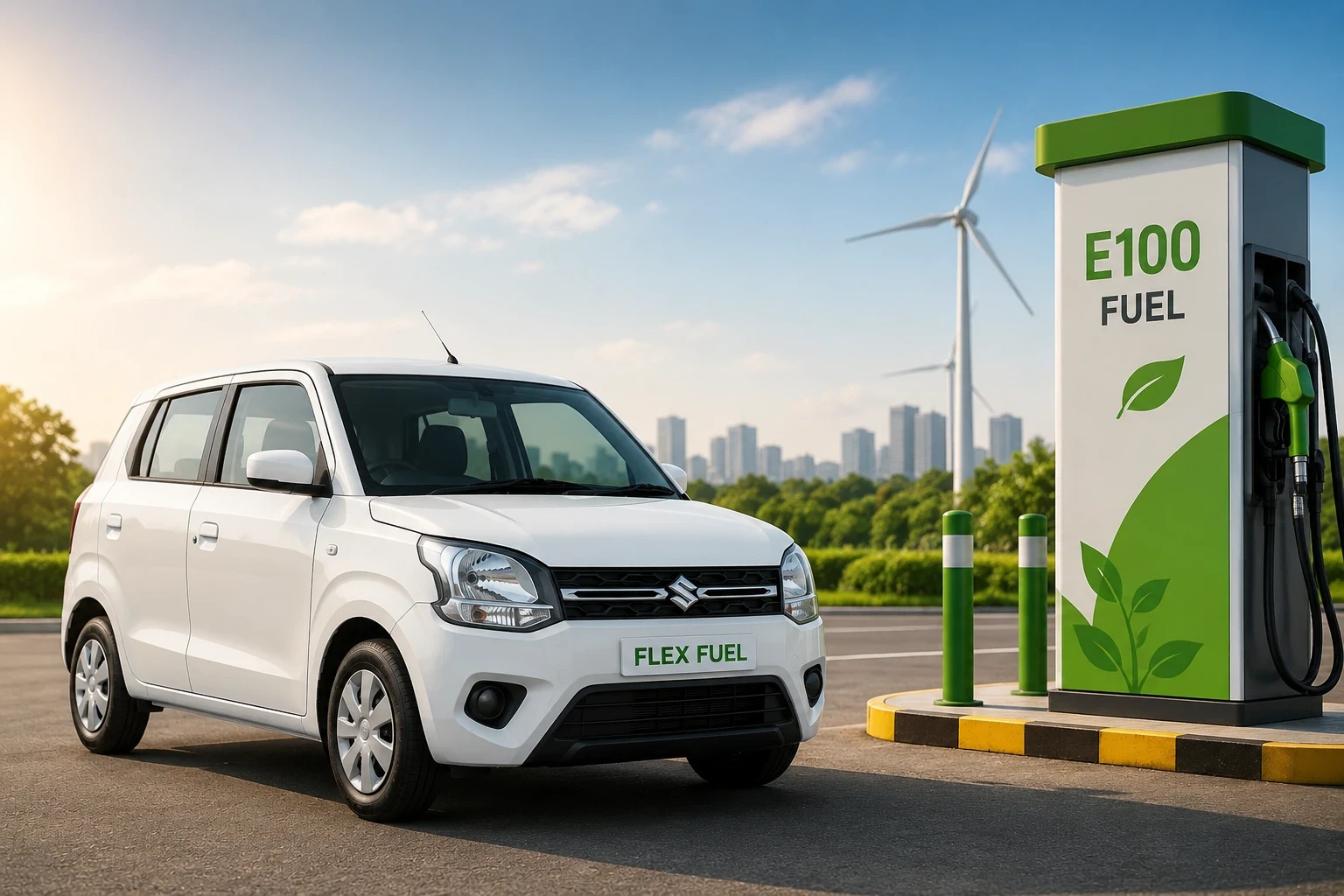
India's biofuel journey reached a major milestone in June 2026 with the launch of its first commercially produced flex-fuel passenger car. As the country moves beyond E20 blending and prepares for wider adoption of E85 and E100 fuels, flex-fuel vehicles (FFVs) are set to transform both the automotive and ethanol industries.
On June 4, 2026, ahead of World Environment Day, Union Ministers Nitin Gadkari and Hardeep Singh Puri unveiled the Maruti Suzuki Wagon R Flex Fuel, India's first commercially produced flex-fuel passenger vehicle.
Unlike earlier prototypes and demonstration models, the Wagon R Flex Fuel is production-ready and capable of running on any blend of petrol and ethanol, from E20 to E100.
The launch marks an important step in India's efforts to reduce crude oil imports, strengthen energy security, and expand the domestic biofuel ecosystem.
A Flex-Fuel Vehicle (FFV) is designed to run on varying blends of petrol and ethanol without requiring any manual intervention from the driver.
Conventional petrol vehicles can generally operate on E20 fuel but are not engineered for significantly higher ethanol concentrations. Using higher blends in standard vehicles can lead to issues such as:
To overcome these challenges, FFVs are equipped with:
The ECU continuously detects the ethanol concentration in the fuel and automatically adjusts fuel injection and ignition timing to ensure optimal performance.
For example, the Wagon R Flex Fuel uses Maruti Suzuki's 1.2-litre K12N engine with ECU calibration that allows seamless operation across ethanol blends from E20 to E100.
As regulations evolve and fuel infrastructure expands, FFVs will enable consumers and fleet operators to gradually shift toward higher ethanol usage without changing vehicles.
India imports nearly 85% of its crude oil requirements, making energy security a national priority. To reduce import dependence and support domestic agriculture, the government has aggressively expanded the Ethanol Blended Petrol (EBP) Programme. By April 2026, India achieved nationwide E20 blending ahead of schedule.
This initiative has highlighted the growing importance of bioethanol as a cleaner transportation fuel.
The results have been significant:
However, E20 was never intended to be the end goal.
The next phase of India's biofuel strategy focuses on enabling vehicles to use significantly higher ethanol blends such as E85 and E100. Flex-fuel vehicles provide the technological foundation for this transition, allowing consumers and fleet operators to adopt higher ethanol blends as fuel availability expands.
The Wagon R Flex Fuel is only the beginning. Several manufacturers have already showcased or announced flex-fuel models for the Indian market.
Flex-fuel adoption is not limited to cars.
Hero MotoCorp has already introduced multiple E100-compatible motorcycles, signaling strong potential for ethanol demand growth in India's massive two-wheeler market.
While vehicle development is progressing rapidly, fuel infrastructure is still in the early stages.
At present, E85 and E100 dispensing stations are available only in limited locations, primarily across:
To address this gap, the government has proposed a phased expansion strategy.
For most consumers purchasing an FFV today, the vehicle will primarily operate on E20 fuel. The advantage lies in future readiness: the ability to immediately use higher ethanol blends as they become available.
As ethanol adoption grows, many consumers are also becoming interested in how fuel-grade ethanol is produced and supplied to the market.
The growth of FFVs has implications far beyond the automotive sector.
Every flex-fuel vehicle becomes a long-term consumer of ethanol-based fuel, creating sustained demand for fuel-grade ethanol and strengthening the broader biofuel value chain.
Higher ethanol blends such as E85 and E100 require ethanol that meets strict fuel-quality standards.
This creates opportunities for:
Maize-based ethanol production is increasingly viewed as a critical component of India's long-term ethanol strategy.
Key advantages include:
As E85 and E100 adoption grows, grain-based feedstocks such as maize and surplus rice are expected to play a larger role in meeting demand.
With Gujarat emerging as a major center for biofuel investments, the state is increasingly being recognized as an ethanol manufacturing hub in India, supporting future growth in fuel-grade ethanol production.
While FFVs offer substantial benefits, several challenges remain.
FFVs require specialized components and fuel systems, increasing manufacturing costs. Current estimates suggest flex-fuel technology may add ₹40,000–₹50,000 to vehicle costs, although this premium is expected to decline as production scales.
Ethanol contains less energy per litre than petrol.
As a result:
However, lower ethanol pricing can offset this difference, helping maintain competitive operating costs per kilometre.
Ethanol production depends on agricultural outputs.
Maintaining reliable supply will require:
Balancing fuel demand, agricultural economics, and food security will remain a key policy challenge.
Over the past several years, India has built the foundation of a large-scale ethanol economy through policy support, blending targets, and capacity expansion.
The launch of the Wagon R Flex Fuel brings these efforts into the consumer market.
And for India, it represents another step toward greater energy security and reduced dependence on imported fossil fuels.
The policy framework is in place, and the first commercial vehicles have arrived. The next stage will depend on expanding fuel infrastructure, strengthening supply chains, and scaling ethanol production nationwide.
India's flex-fuel transition has moved from concept to reality. With the launch of the Wagon R Flex Fuel and a growing pipeline of FFV models from major manufacturers, the country is preparing for a future where E85 and E100 fuels become increasingly accessible.
Although fuel infrastructure and production capacity still need to expand, the direction is clear. As more flex-fuel vehicles reach Indian roads, demand for high-quality ethanol will continue to grow, creating opportunities across agriculture, distillation, logistics, and energy sectors.
For stakeholders across the biofuel value chain, FFVs represent more than a new vehicle technology, they represent the next phase of India's ethanol economy and a significant step toward greater energy security.
Companies like Edhas Biofuel are well-positioned to support this growth by supplying high-quality ethanol for E20, E85, and E100 applications, helping drive the next phase of India's sustainable mobility transition.
A flex-fuel vehicle is designed to run on different blends of petrol and ethanol, ranging from E20 to E85 or even E100, without requiring any manual adjustments by the driver. The vehicle's engine management system automatically adapts to the fuel blend being used.
No. Most conventional petrol vehicles in India are designed to operate on petrol or lower ethanol blends such as E20. Running E100 in a standard petrol vehicle can damage fuel system components and affect engine performance. Dedicated flex-fuel vehicles are required for higher ethanol blends.
India's first commercially produced flex-fuel passenger car is the Maruti Suzuki Wagon R Flex Fuel. Other manufacturers, including Tata Motors, Toyota, Hyundai, and Hero MotoCorp, have also showcased or announced flex-fuel vehicles and motorcycles for the Indian market.
E85 and E100 fuel stations are currently available only at select locations. However, the government has announced plans to significantly expand ethanol fuel infrastructure across major cities, industrial corridors, and transportation routes over the next few years.
As FFV adoption grows, demand for fuel-grade ethanol is expected to increase substantially. This creates opportunities for ethanol producers, distilleries, farmers, and biofuel companies while supporting India's goals of reducing crude oil imports and strengthening energy security.

Get the latest updates on renewable energy, sustainability trends, and our initiatives delivered straight to your inbox.