
Subscribe to Our Newsletter
Join our community and stay updated.

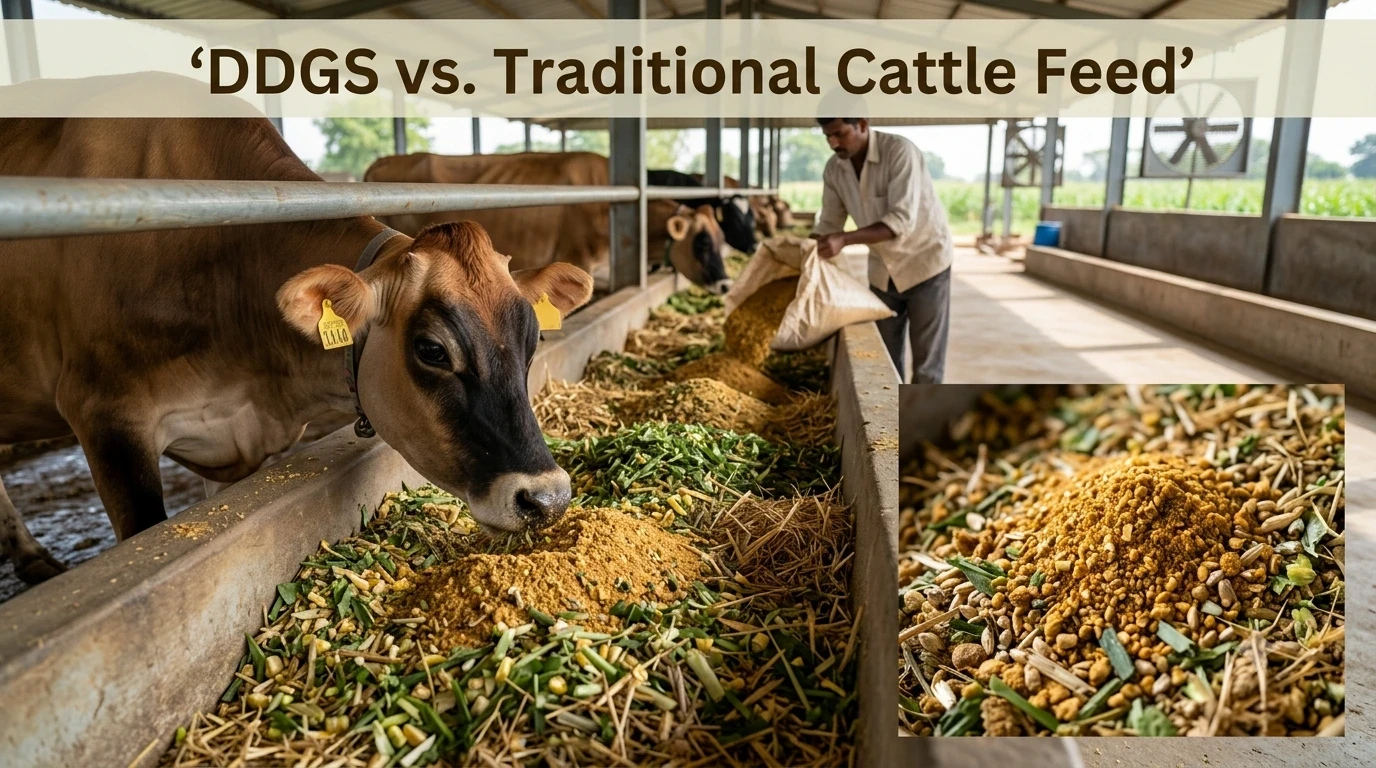
Feed costs are among the largest expenses in dairy and livestock farming in India. Protein-rich ingredients such as soybean meal and oilseed cakes can be particularly expensive and subject to significant price fluctuations. At the same time, many cattle rations need a better balance of protein, energy, fibre, and digestible nutrients to support consistent milk production and healthy weight gain.
Dried Distillers Grains with Solubles (DDGS), a co-product of grain-based ethanol production, has emerged as a practical feed ingredient for addressing this challenge. As India's maize-based ethanol industry expands, domestic DDGS availability is also increasing, creating an additional source of protein and energy for feed manufacturers and livestock farmers.
But how does DDGS actually compare with conventional cattle feed ingredients?
This guide compares DDGS with common Indian feed ingredients across three key parameters: protein content, digestibility, and cost efficiency while also highlighting where DDGS fits best in a balanced cattle ration.
Indian cattle rations typically combine roughage, energy sources, and protein supplements.
Common ingredients include:
Oilseed meals generally provide the highest protein among conventional ingredients. However, their prices are influenced by oilseed availability, edible oil demand, weather conditions, and domestic and international markets.
This is where DDGS can offer an alternative source of concentrated protein and energy.
DDGS is produced when grain, primarily maize in India's ethanol industry, is fermented and distilled to produce ethanol.
During fermentation, much of the grain's starch is converted into ethanol. The remaining nutrients, including protein, fibre, fat, minerals, and B-vitamins, become concentrated in the residual material. After drying, this material is sold as DDGS.
Because maize is the leading feedstock for Indian ethanol production, maize DDGS is currently the most relevant type for Indian cattle feed. Rice-based DDGS is also gaining attention as broken rice increasingly enters the ethanol supply chain.
The important difference is that DDGS contains substantially less starch than the original grain while concentrating protein, fibre, and fat. This makes it useful as both a protein and energy ingredient, rather than simply an additional source of dietary starch.
Maize DDGS commonly contains around 27–31% crude protein on a dry-matter basis, although actual values vary by plant and production process. Wheat DDGS can contain approximately 33–38% protein.
This places DDGS well above raw maize and bran and broadly in the range of several oilseed cakes. However, soybean meal still has a higher crude protein concentration.
One important advantage of DDGS is that its protein is not simply evaluated by crude protein percentage. Its rumen-degradable and rumen-undegradable protein fractions also matter when formulating rations for high-producing dairy cattle.
Feed Ingredient |
Approx. Crude Protein |
Primary Role |
|---|---|---|
| Raw maize | ~8–9% | Energy source |
| Wheat/rice bran | ~12–15% | Energy, fibre, moderate protein |
| Maize DDGS | ~27–31% | Protein + energy |
| Wheat DDGS | ~33–38% | Protein + energy |
| Mustard cake | ~30–38% | Protein source |
| Soybean meal | ~44–48% | High-protein ingredient |
Actual nutrient values vary by variety, processing method, supplier, and batch. Ration formulation should therefore use the supplier's current laboratory analysis.
DDGS does not replace soybean meal based on protein percentage alone. Its value comes from combining protein, digestible fibre, and energy in a single ingredient.
Protein percentage tells only part of the story. What matters nutritionally is how much of that protein and energy the animal can actually use.
A portion of DDGS protein can escape degradation in the rumen and reach the small intestine as rumen-undegradable protein (RUP). This provides amino acids directly to the animal after intestinal digestion.
For high-producing dairy cattle, this can be useful because microbial protein produced in the rumen alone may not always meet the animal's metabolizable protein requirements.
However, the actual RUP level and digestibility depend on factors such as the grain used, processing conditions, drying temperature, and DDGS quality. Therefore, DDGS should not be treated as nutritionally identical across every supplier.
Another advantage of DDGS is its relatively low starch concentration compared with the original grain. Much of the maize starch is removed during ethanol production.
DDGS can therefore contribute digestible fibre and energy without adding as much starch as an equivalent quantity of maize. This can be useful when formulating rations where excessive rapidly fermentable starch needs to be controlled.
By comparison:
The goal isn't to choose one ingredient over all others. It is to combine them into a ration that meets the animal's nutrient requirements.
However, inclusion should always be based on the complete ration rather than a fixed percentage. Excessive DDGS can increase dietary fat or phosphorus and may create nutrient imbalances.
A commonly cited practical range is around 15–25% of ration dry matter, but the appropriate inclusion level depends on animal type, production stage, DDGS composition, forage quality, and the rest of the ration. A qualified nutritionist should determine the final formulation.
The cheapest feed ingredient per kilogram isn't necessarily the most economical.
A better comparison is cost per kilogram of usable protein or cost per unit of nutrient delivered.
For example, comparing a ₹30/kg ingredient with a ₹40/kg ingredient doesn't tell you which is more economical until you consider their respective protein concentrations and the quantity required to meet the ration's nutritional target.
Because DDGS contains substantially more protein than maize or bran, a feed formulator may use less DDGS to achieve a particular protein contribution. It can also partially replace more expensive protein ingredients while contributing energy and fibre.
Traditional protein sources such as soybean meal and mustard cake are closely connected to oilseed markets. Their prices can change with crop yields, edible oil demand, imports, exports, and seasonal conditions.
DDGS, on the other hand, is a co-product of ethanol production. Its availability is therefore linked to the expansion of India's ethanol industry rather than being driven exclusively by the oilseed market.
As India's ethanol blending programme expands, domestic DDGS production can provide feed manufacturers with another locally sourced protein ingredient.
For current market considerations, see our guide to DDGS price, uses, and benefits.
DDGS is a dry, concentrated feed ingredient that can be stored more easily than fresh green fodder when appropriate storage conditions are maintained. It should still be protected from moisture to prevent spoilage and mould.
Industrial production can provide relatively consistent DDGS specifications, but nutrient composition still varies between ethanol plants and batches. Protein, fat, fibre, phosphorus, moisture, and other parameters should therefore be checked before formulation.
Although this article focuses on cattle, DDGS is also used in feed formulations for poultry, aquaculture, and other livestock. Nutritional specifications and recommended inclusion levels differ significantly by species.
DDGS should not be viewed as a complete replacement for conventional cattle feed and it cannot replace essential roughage.
Instead, it is best considered a high-value ration ingredient that can partially replace protein and energy sources such as oilseed meals, maize, or bran, depending on the nutritional requirements of the animal.
Its main advantages are:
The key is to evaluate DDGS based on nutrient value and cost per unit of protein, rather than simply its price per kilogram.
DDGS is becoming an increasingly relevant ingredient in India's evolving livestock feed market. While it does not match soybean meal for crude protein concentration, its combination of protein, digestible fibre, energy, and potentially favourable economics makes it worth considering as part of a properly balanced cattle ration.
As India's maize-based ethanol capacity continues to expand, particularly in emerging production hubs such as Gujarat, the domestic availability of quality DDGS is expected to become increasingly important for feed manufacturers and livestock producers.
At Edhas Biofuel, DDGS is a core part of our by-product portfolio, produced as part of our maize-based ethanol operations. If you're evaluating DDGS for your feed formulation or looking for a reliable supply partner, get in touch with our team.
Yes. DDGS is widely used in dairy rations as a protein and energy supplement. Its bypass protein content can support milk yield, though inclusion is typically kept to around 15–20% of ration dry matter to balance fat and phosphorus levels.
Maize DDGS typically contains around 27–31% crude protein, compared to roughly 44–48% for soybean meal. DDGS is generally used to replace a portion of soybean meal or oilseed cake in a ration, not as a full substitute.
DDGS pricing depends on regional ethanol production and prevailing feed markets, but because its supply is tied to ethanol output rather than the edible oil market, it tends to be less exposed to the price volatility that affects oilseed cakes and soybean meal.
Yes, DDGS can be fed daily as part of a balanced ration. Most nutrition guidance recommends keeping it to roughly 15–25% of total ration dry matter, with adjustments made for fat and phosphorus content depending on the animal's stage and production level.
DDGS is dried to a stable moisture level for storage and generally holds up well under proper conditions. It typically stores more predictably than oilseed cakes, which are more prone to moisture pickup and mould in humid environments.
DDGS is used in poultry and aquaculture feed as well, though inclusion rates and protein requirements differ from cattle rations. Species-specific formulation guidance should be followed.

Get the latest updates on renewable energy, sustainability trends, and our initiatives delivered straight to your inbox.