
Subscribe to Our Newsletter
Join our community and stay updated.

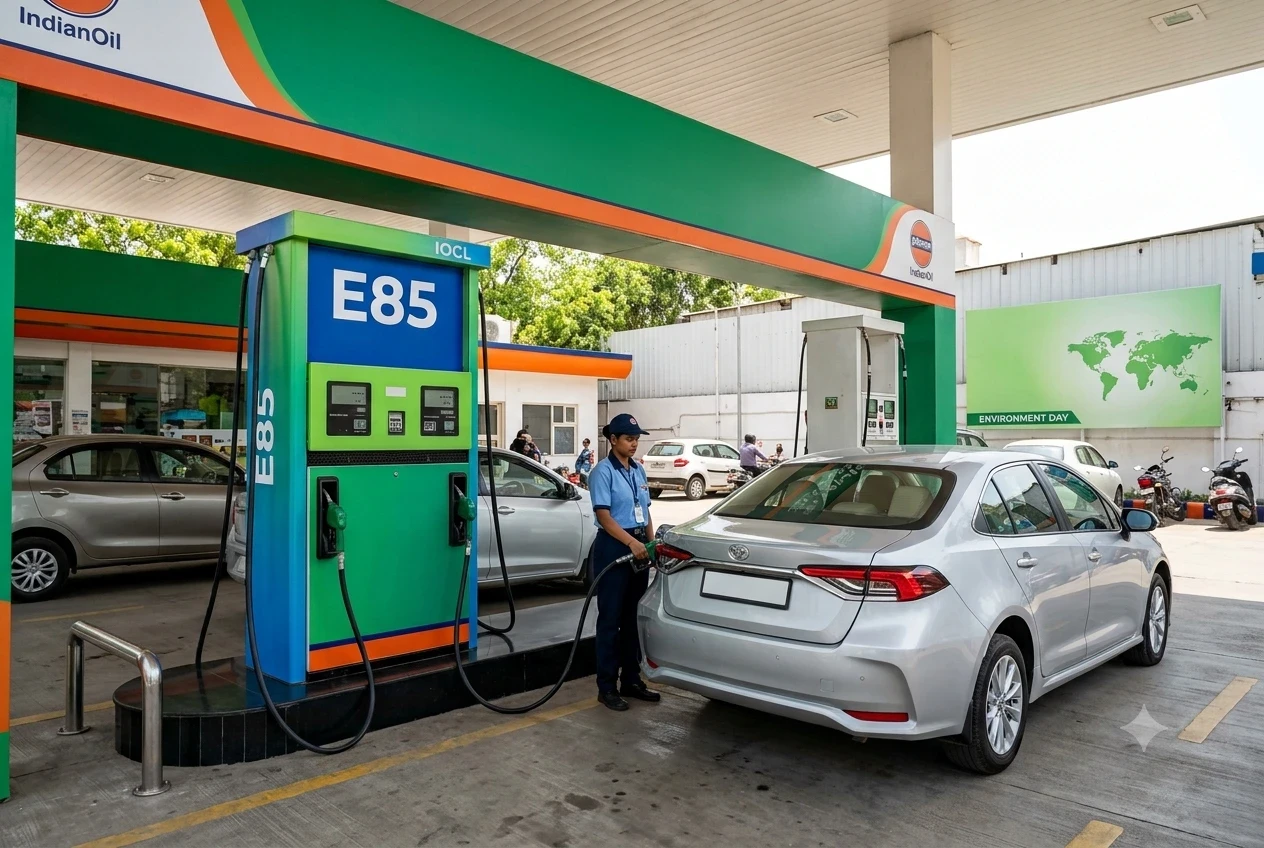
India's ethanol programme has entered a new phase. On June 5, 2026, World Environment Day, Union Minister for Petroleum and Natural Gas Hardeep Singh Puri launched E85 fuel at an IndianOil retail outlet in New Delhi. The initial rollout covers 48 public-sector oil company retail outlets, with plans to expand to around 500 outlets by December 2026 and approximately 5,000 outlets by December 2027.
For most Indian motorists, E85 is still a niche fuel. But its arrival is significant because it introduces a new high-ethanol fuel option alongside the country's established E20 programme and creates a clearer pathway for flex-fuel vehicles (FFVs).
So, what exactly is E85, who can use it, and what does the rollout mean for India's growing ethanol industry?
E85 is a high-ethanol petrol blend containing approximately 80–85% ethanol and 14–19% petrol. It is specifically intended for vehicles engineered and certified to operate on high-ethanol blends.
That makes E85 fundamentally different from E20, the petrol blend now used across India.
A conventional petrol vehicle should not be treated as an E85 vehicle simply because it can run on E20. E85 requires a compatible flex-fuel powertrain, including fuel-system components and engine-management calibration designed to accommodate substantially higher ethanol concentrations.
Flex-fuel vehicles are designed to detect the fuel's ethanol concentration and automatically adjust parameters such as fuel injection and ignition timing. Depending on the vehicle's certification, an FFV can operate across a broad range of ethanol-petrol blends.
One of ethanol's major technical advantages is its high octane rating. Ethanol has a Research Octane Number (RON) of approximately 108, providing strong resistance to engine knock and giving engineers greater scope to optimize combustion in engines designed for it.
The important distinction is simple:
India's ethanol programme has expanded rapidly over the past decade. Average ethanol blending increased from about 1.5% in 2013–14 to 20% in 2025–26, with the 20% target being achieved five years ahead of the original schedule.
At the same time, production capacity has expanded substantially. Government data puts India's ethanol production capacity at approximately 2,000 crore litres, or 20 billion litres, in 2026, compared with 421 crore litres in 2014.
The government has also indicated that current capacity is considerably higher than the roughly 11 billion litres required to sustain the E20 mandate, creating room to consider additional applications for domestically produced ethanol.
This is where E85 becomes relevant.
Rather than relying exclusively on increasing the ethanol percentage in the country's general petrol pool, a dedicated E85 ecosystem creates another channel for ethanol demand, provided that enough compatible vehicles and retail infrastructure are developed.
Importantly, E85 does not mean India's nationwide petrol blend has been raised beyond E20. The government has explicitly clarified that E85 is being introduced exclusively for specially designed FFVs and does not constitute an increase in the nationwide base blending level.
Price is likely to be one of the most visible factors for consumers.
At launch, E85 was priced at approximately ₹20 per litre below conventional E20 petrol, according to the Ministry of Petroleum and Natural Gas.
That creates a straightforward incentive for FFV owners to consider the fuel.
However, comparing the pump price alone does not tell the entire story. Ethanol contains less energy per litre than petrol, so an FFV running on E85 can consume more fuel for the same distance compared with petrol.
For consumers, therefore, the more useful metric is cost per kilometre, rather than simply the price displayed on the fuel dispenser.
Actual savings will depend on the vehicle, driving conditions, fuel prices and the difference in fuel economy between petrol and E85.
India's FFV market is still at an early stage, but several manufacturers have now moved beyond demonstrations and pilots.
Maruti Suzuki launched India's first flex-fuel passenger car in June 2026, based on the WagonR. The vehicle's engine-management system is designed to adapt to ethanol blends from E20 to E100, although the vehicle is homologated for E85 under India's current regulatory framework.
This distinction is important: technical compatibility with a particular fuel and regulatory homologation are not necessarily identical.
Hero MotoCorp unveiled flex-fuel versions of the Splendor+ and HF Deluxe on June 3, 2026. The motorcycles are compatible with ethanol blends ranging from E20 to E85. Hero announced an initial introduction in Delhi and selected regions of Maharashtra, followed by a wider rollout.
The significance here is the two-wheeler segment. Motorcycles account for a substantial share of India's personal mobility market, so FFV adoption in this category could materially influence future ethanol demand.
Toyota has also been developing flex-fuel technology through its Corolla Altis Flexi-Fuel Strong Hybrid Electric Vehicle (FFV-SHEV) pilot.
The vehicle combines a flex-fuel engine with a strong-hybrid electric powertrain, providing two pathways for reducing conventional fuel consumption: greater ethanol use and electric operation. Toyota's pilot project was launched in India in 2022.
Maruti Suzuki's WagonR and Hero's motorcycles show that the technology is moving toward actual vehicles, while other manufacturers have demonstrated flex-fuel concepts and prototypes.
The next question is whether manufacturers move from limited introductions and demonstrations to larger-scale commercial availability as E85 infrastructure expands.
For someone who already owns or is considering an FFV, the rollout creates new possibilities but there are still practical limitations.
The initial network of 48 outlets is small compared with India's overall petrol station network.
That means E85 cannot yet be treated as a universally available fuel. The planned expansion to approximately 500 outlets by December 2026 and 5,000 by December 2027 should improve access, but coverage will initially remain concentrated in selected locations.
For longer trips, checking E85 availability along the route will remain important.
E85 should not be used in an ordinary petrol vehicle simply because that vehicle is compatible with E20.
The fuel is intended for specially designed and certified FFVs. The safest reference is always the vehicle manufacturer's fuel specification and owner's manual.
The roughly ₹20-per-litre price difference is attractive, but lower energy density means mileage can differ.
For an accurate comparison, owners should track:
Fuel cost per kilometre = Fuel price per litre × Litres consumed ÷ Distance travelled
This gives a better indication of the real operating cost than comparing petrol and E85 prices alone.
For ethanol producers, the significance of E85 goes beyond the number of fuel stations.
India has spent years expanding ethanol production capacity to support the EBP programme. Production capacity has grown from 421 crore litres in 2014 to around 2,000 crore litres in 2026, according to government data.
As the market develops, demand for ethanol will increasingly depend on more than the conventional petrol-blending programme.
That makes feedstock availability, production efficiency and supply reliability increasingly important.
Grain-based and sugar-based ethanol will continue to play roles in the country's biofuel ecosystem, while policy is also supporting development of advanced biofuels and other applications.
This is particularly relevant as the industry looks beyond road transport. Sustainable aviation fuel (SAF), industrial applications and other biofuel pathways could become additional outlets for ethanol and related feedstocks as India's biofuel ecosystem matures.
For producers, the important question is therefore not simply how much ethanol India can produce, but how many different demand channels can develop alongside that capacity.
The E85 rollout also fits into a wider policy objective: reducing dependence on imported fossil fuels while increasing the use of domestically produced renewable fuels.
The government has highlighted ethanol's potential to reduce crude-oil dependence, support agricultural value chains and retain more energy expenditure within the domestic economy.
At the same time, E85 should be viewed as one component of India's wider transport-energy transition, rather than a replacement for every other fuel technology.
Electric vehicles, hybrids, CNG/CBG, biofuels and other technologies are developing in parallel. For FFVs, ethanol offers a way to increase renewable fuel use without requiring the complete replacement of the existing internal-combustion vehicle architecture.
Several developments will determine how quickly India's E85 ecosystem develops:
India's E85 launch is still small in scale, but it represents an important shift in the country's ethanol story.
The initial 48 retail outlets are only the starting point. The planned expansion to 500 outlets in 2026 and around 5,000 in 2027, combined with the arrival of dedicated FFVs, gives high-ethanol fuel a physical presence in India's transport ecosystem.
E85 is therefore less about what is happening at 48 fuel stations today and more about what those stations could represent over the next several years: the beginning of a broader market for high-ethanol fuels in India.
Interested in how India's expanding ethanol demand could affect feedstock requirements and supply planning? Get in touch with Edhas Biofuel to discuss what the next phase of India's biofuel market could mean for your business.
E85 is a fuel blend of 80–85% ethanol and 14–19% petrol, designed exclusively for flex-fuel vehicles (FFVs). It has a higher octane rating than regular petrol but cannot be used in standard petrol engines.
E85 launched on June 5, 2026 at 48 public sector fuel stations across India. The government plans to expand this to 500 stations by December 2026 and around 5,000 stations by December 2027.
No. E85 can only be used in flex-fuel vehicles (FFVs) built to run on ethanol blends ranging from E20 to E100. Using it in a standard petrol engine can damage the fuel system and isn't recommended.
Current E85-compatible vehicles include the Maruti Suzuki Wagon R Flex Fuel, Hero MotoCorp's Splendor+ and HF Deluxe, and Toyota's FFV-SHEV Corolla pilot. More models, including the Maruti Fronx FFV, are expected to launch soon.
Yes. The government has priced E85 at roughly ₹20 per litre below conventional petrol, making it a lower-cost fuel option for flex-fuel vehicle owners, though mileage per litre may be slightly lower due to ethanol's energy density.

Get the latest updates on renewable energy, sustainability trends, and our initiatives delivered straight to your inbox.