
Subscribe to Our Newsletter
Join our community and stay updated.

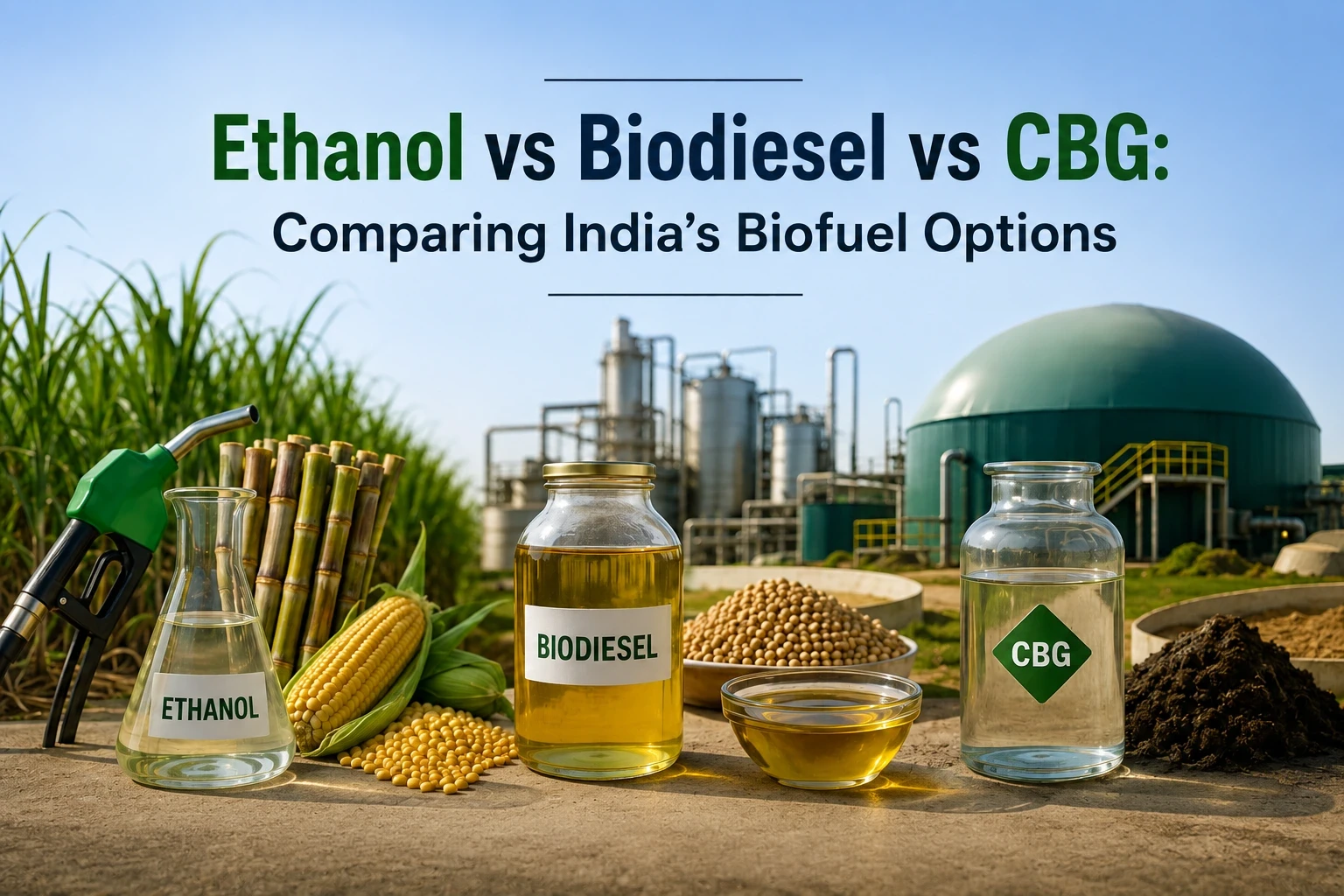
India's transition to cleaner fuels is moving along several paths at once. Ethanol, biodiesel, and Compressed Biogas (CBG) are three of the country's key biofuel options, but they serve different parts of the energy market.
Ethanol is primarily used to replace petrol, biodiesel is blended with diesel, and CBG is positioned as a renewable alternative to CNG and natural gas.
Their feedstocks, technologies, supply chains, government policies, and commercial challenges are also very different.
As India's biofuel industry enters a new phase, understanding these differences is important for producers, investors, farmers, and businesses looking at opportunities in renewable energy.
The simplest way to distinguish the three fuels is by what they replace:
This also determines how each market develops.
Ethanol benefits from established agricultural and fuel-distribution networks. Biodiesel depends heavily on collecting waste oils and fats from fragmented sources. CBG requires the aggregation of agricultural and organic waste and access to gas distribution infrastructure.
As a result, the three markets are currently at very different stages of maturity.
Ethanol is currently India's most successful large-scale biofuel programme.
It is produced from feedstocks such as sugarcane, molasses, and sugarcane juice, maize, broken rice, and other grains. It is blended with petrol under the Ethanol Blended Petrol (EBP) Programme.
India has reached the 20% ethanol-blending milestone, advancing the target that was originally set for 2030. Government data shows ethanol blending increased significantly over the past several years, reaching almost 18% during ESY 2024-25.
The next stage, however, is less certain. As of July 2026, the government has said that no decision has been taken to increase the nationwide base blending level beyond E20. Higher blends could be considered after further technical studies and stakeholder consultations.
Several factors supported rapid industry growth:
This gave producers greater demand visibility and encouraged significant investment in production capacity.
Ethanol's success has created a new question: what happens to capacity if domestic demand does not grow beyond E20 quickly?
Producers now need to consider capacity utilisation, feedstock costs, higher-value applications, flex-fuel vehicles, 2G ethanol, and potential future increases in blending.
The industry has therefore moved from a pure capacity-expansion phase toward a more complex phase focused on efficiency and market development.
Biodiesel is intended to play a role similar to ethanol, but in the diesel market. India's National Policy on Biofuels has an indicative target of 5% biodiesel blending in diesel by 2030.
Biodiesel can be produced from:
As of 2026, the actual blend rate is still below 1%. Production has grown, expected to rise to roughly 640 million litres in 2026, but that's a small fraction of what a genuine 5% blend would require nationally.
|| Related Read: Ethanol-Diesel Blending
The biggest challenge is feedstock collection.
Unlike sugarcane or maize, which can move through established agricultural supply chains, used cooking oil is generated in relatively small quantities across thousands of restaurants, hotels, food processors, commercial kitchens, and other establishments.
Collecting, transporting, aggregating, and processing this material economically requires a well-developed supply chain.
The government's Repurpose Used Cooking Oil (RUCO) initiative has sought to create a formal ecosystem for collecting UCO and converting it into biodiesel and other products. However, fragmented collection remains a major industry challenge.
The opportunity extends beyond road transportation.
Used cooking oil is also an important potential feedstock for Sustainable Aviation Fuel (SAF). As global demand for lower-carbon aviation fuels grows, biodiesel and SAF producers could increasingly compete for the same waste-based feedstocks.
That makes India's UCO collection infrastructure strategically important for more than one renewable-fuel market.
Compressed Biogas (CBG) represents a different approach to biofuel production. CBG is purified biogas that can be used as a renewable alternative to CNG and, in suitable applications, natural gas.
It can be produced from a wide range of organic materials, including:
This gives CBG an important connection to both renewable energy and waste management and comes with its own set of trade-offs worth understanding.
The SATAT initiative, launched in 2018, was designed to encourage CBG production from waste and biomass and create an ecosystem around its purchase and distribution.
The policy environment has now evolved further through the GOBARdhan framework.
CBG blending obligations for CNG (Transport) and PNG (Domestic) segments under city gas distribution networks are scheduled to increase from 3% in FY2026-27 to 4% in FY2027-28 and 5% from FY2028-29 onwards.
This is important because it creates a stronger demand signal for CBG producers.
The framework also includes support mechanisms such as capital assistance, feedstock aggregation support, and measures intended to improve project viability. Eligible greenfield projects can receive capital assistance of up to ₹2 crore per tonne per day (TPD) of installed CBG capacity.
A CBG plant does not produce only gas.
The anaerobic digestion process also produces digestate that can be processed into Fermented Organic Manure (FOM) and other organic soil amendments, a co-product model not unlike how ethanol distilleries monetise DDGS as a by-product.
This creates the possibility of multiple revenue streams:
Organic waste → CBG + Organic Manure
For India, where agricultural waste and organic waste are available in large quantities, this circular-economy model could become increasingly important.
Factor |
Ethanol |
Biodiesel |
Compressed Biogas (CBG) |
|---|---|---|---|
| Replaces | Petrol | Diesel | CNG / Natural Gas |
| Major feedstocks | Sugarcane, maize, broken rice, other grains | Used cooking oil, animal fats, non-edible oils | Cattle dung, crop residues, press mud, organic waste |
| Market maturity | Mature | Developing | Emerging |
| Key policy | Ethanol Blended Petrol (EBP) Programme | National Policy on Biofuels / RUCO | SATAT / GOBARdhan |
| Blending target/status | E20 | 5% indicative target by 2030 | 5% CBG obligation from FY2028-29 |
| Major challenge | Demand and capacity utilisation beyond E20 | Feedstock collection and cost | Feedstock aggregation and project economics |
| Key by-products | DDGS and other co-products | Glycerol | FOM / organic manure |
| Main opportunity | 2G ethanol, flex-fuel and higher blends | UCO and SAF | Waste-to-energy and circular agriculture |
The three markets highlight an important lesson: biofuel growth depends on more than production technology.
Feedstock availability, logistics, government policy, infrastructure, and reliable offtake all have to develop together.
Ethanol demonstrates how strong policy support and assured demand can rapidly scale a biofuel industry.
Its next challenge is determining how the market develops after E20 and how producers manage capacity and feedstock economics.
Biodiesel has significant potential, but its growth depends heavily on developing efficient UCO and waste-feedstock collection networks.
The opportunity could become even more valuable as biodiesel competes with or complements emerging SAF markets.
CBG has gained stronger policy momentum through mandatory blending obligations and new project-support mechanisms.
Its success will depend on whether developers can solve the practical challenges of feedstock aggregation, plant utilisation, financing, transportation, and gas offtake.
India's biofuel transition is unlikely to be dominated by a single technology.
Instead, different biofuels will serve different parts of the energy system.
This diversity is one of India's biggest advantages. Agricultural residues, food waste, animal waste, and other organic resources can be converted into energy while also creating additional economic value.
For producers and investors, the opportunity lies in identifying the right feedstock, technology, location, and end market rather than treating all biofuels as the same industry.
Ethanol, biodiesel, and CBG represent three different stages of India's biofuel journey.
Ethanol is the most mature market and has demonstrated the impact of blending mandates and assured procurement. Biodiesel remains a significant opportunity, but its growth is constrained by feedstock collection and economics. CBG is emerging as a promising waste-to-energy market, supported by stronger policy measures and mandatory blending requirements.
The next phase of India's biofuel transition will depend on how effectively the industry connects feedstock, technology, infrastructure, policy, and demand.
For companies operating across the biofuel value chain, this creates opportunities not only in fuel production but also in waste aggregation, feedstock processing, logistics, by-products, and circular-economy solutions.
At Edhas Biofuel, we continue to explore the technologies, feedstocks, and market developments shaping India's renewable-fuel industry.
Ethanol is primarily blended with petrol, biodiesel is blended with diesel, and Compressed Biogas (CBG) is used as a renewable alternative to CNG and natural gas. They also use different feedstocks: ethanol mainly uses sugar- and starch-based crops, biodiesel uses oils and fats, while CBG uses organic waste and biomass.
There is no single best biofuel because each serves a different energy market. Ethanol is currently the most mature, biodiesel has significant potential if feedstock collection improves, and CBG is an emerging opportunity because it can convert agricultural and organic waste into renewable gas and organic manure.
Ethanol is produced mainly from sugarcane, molasses, maize, broken rice and other grains. Biodiesel can use used cooking oil, animal fats and non-edible oils, while CBG can be produced from cattle dung, crop residues, press mud, food waste and other organic materials.
India has reached the E20 ethanol-blending milestone for petrol. The indicative target for biodiesel is 5% blending by 2030. For CBG, the blending obligation for the relevant CNG and PNG segments is scheduled to increase from 3% in FY2026-27 to 5% from FY2028-29.
The challenges differ by fuel. Ethanol faces questions around demand and capacity utilisation beyond E20. Biodiesel is constrained by the collection and cost of waste-oil feedstocks. CBG faces challenges in feedstock aggregation, project financing, plant utilisation and gas offtake. Improving these supply chains will be critical to India's next phase of biofuel growth.

Get the latest updates on renewable energy, sustainability trends, and our initiatives delivered straight to your inbox.