
Subscribe to Our Newsletter
Join our community and stay updated.

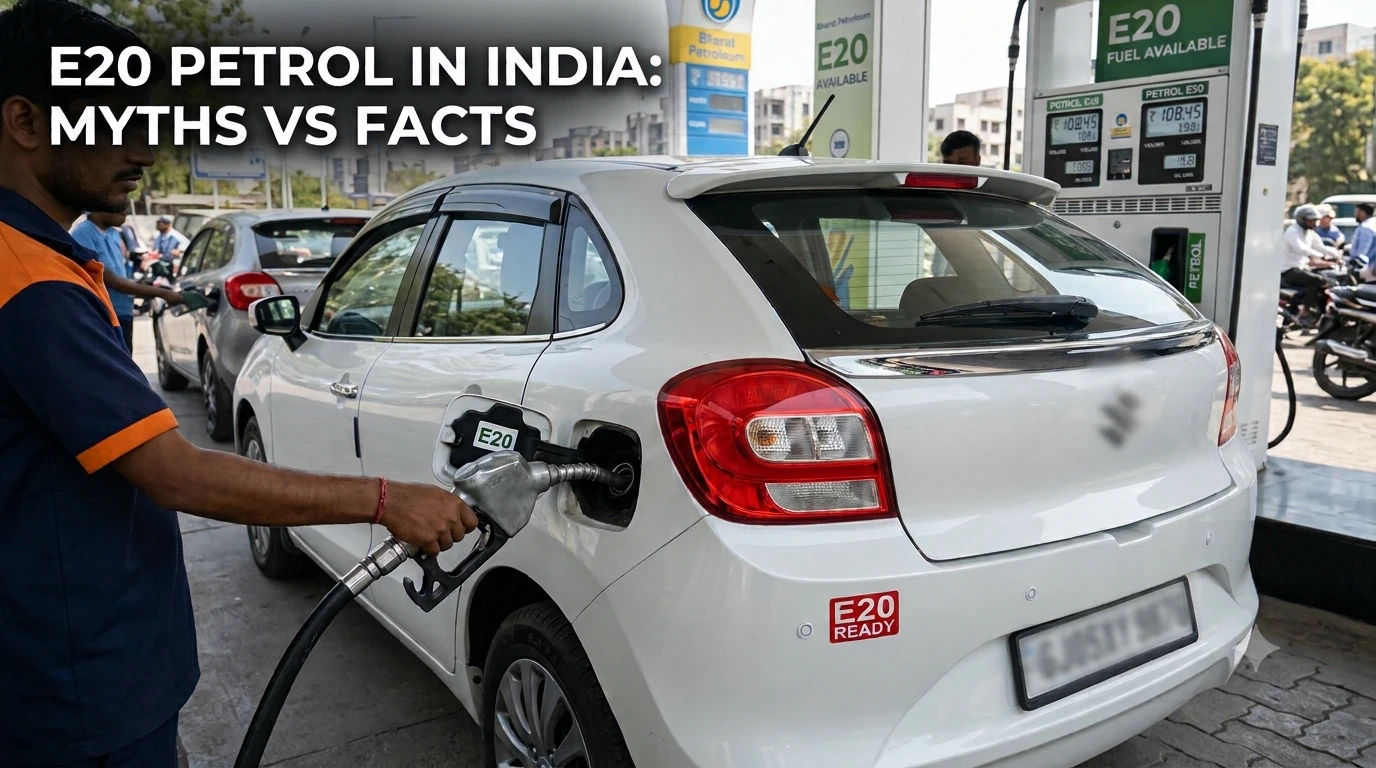
E20 petrol is becoming the standard fuel at petrol pumps across India, but many vehicle owners still have questions about its effects. Will it reduce mileage? Can it damage an older engine? Will manufacturers honour warranties if something goes wrong?
Online discussions often exaggerate the risks, while some claims overlook the practical limitations of ethanol-blended fuel. The reality depends on your vehicle's age, fuel-system materials and manufacturer specifications.
In this guide, we separate nine common E20 petrol myths from the facts, explain which vehicles may be compatible and share practical steps to help you make informed decisions.
E20 petrol contains 20% ethanol and 80% petrol by volume. Ethanol is a renewable, alcohol-based fuel produced from domestic feedstocks such as sugarcane, maize, and surplus agricultural grains.
India moved rapidly from E5 to E10 and reached its 20% blending milestone well ahead of the original 2030 target. Expanding ethanol blending helps reduce crude oil imports, supports domestic agriculture, and diversifies the national energy supply. However, because ethanol contains less energy per liter than conventional petrol, it introduces specific performance and maintenance considerations.
Fact: E20 does not automatically damage an engine, but vehicle compatibility dictates long-term maintenance needs.
Accelerated wear on older rubber components is a routine maintenance issue, not a sign of catastrophic engine failure.
What to do: Check your owner’s manual, and have fuel lines inspected if you detect leaks, unusual fuel odours, or rough idling.
Fact: A minor mileage reduction is real due to lower energy density, but claims of a 20% to 30% drop are false.
Pure ethanol contains roughly 33% less energy per litre than standard petrol. Blending 20% ethanol into petrol leads to a small, predictable drop in fuel efficiency.
While controlled tests show only a single-digit drop, some owners of older or non-calibrated vehicles report larger variations. Fuel economy is heavily influenced by external variables such as tire pressure, traffic congestion, AC usage, driving style, and overall vehicle maintenance which often amplify perceived fuel loss.
Plan for a slight, modest drop in mileage rather than expecting catastrophic loss.
What to do: To accurately measure your vehicle's performance, track consumption over several full tank refills under similar driving conditions rather than relying on a single trip.
Fact: Car manufacturers and industry bodies have confirmed that using E20 will not automatically invalidate your vehicle warranty.
Fuel Specifications Matter: Using E20 in an E20-approved vehicle keeps your warranty fully intact.
Claim Validation: No manufacturer can deny a warranty claim purely because E20 was used, unless they can conclusively prove that unapproved fuel directly caused a specific component failure.
Your warranty remains valid, but maintaining proper service records is essential for smooth claim processing.
What to do: If your vehicle is an older model not explicitly badged for E20, obtain written confirmation from an authorized service center regarding coverage for fuel-system maintenance.
Fact: While ethanol has solvent properties that can affect certain materials, modern E20-compatible vehicles are built with ethanol-resistant metals, plastics, and elastomers.
Corrosion is a material compatibility and maintenance issue, not an inevitable chemical reaction that destroys properly designed fuel tanks.
What to do: For older vehicles, have rubber fuel lines and seals periodically inspected, and avoid letting fuel sit stagnant in the tank for extended periods.
Fact: Older vehicles can run on E20 petrol without immediate operational failure, though long-term maintenance needs may vary.
Manufacturer Material Readiness: Many automakers switched to ethanol-resistant materials years before E20 became standard:
What Actually Happens in Older Engines: Non-certified older engines will start and run normally on E20. However, owners should anticipate a slightly higher mileage drop and faster wear on vintage rubber seals and fuel lines over extended use.
A vehicle running smoothly on E20 today does not mean its legacy fuel lines are immune to long-term wear. The distinction lies in preventative maintenance, not immediate mechanical incompatibility.
Your older car or two-wheeler won't stall or break down simply from using E20, but legacy rubber components deserve periodic checks.
What to do: Check your fuel cap or owner's manual for E20 badges. If your vehicle pre-dates 2010, ask your mechanic to inspect rubber fuel lines and gaskets during routine services.
Fact: E20 does not cause widespread starting issues in typical Indian weather conditions.
If your vehicle experiences hard starts, inspect these common components:
Cold-start issues linked to E20 are rare in tropical and temperate climates.
What to do: Have a technician perform a basic diagnostic on your battery, spark plugs, and fuel system before attributing starting trouble to E20 petrol.
Fact: While ethanol does absorb moisture, phase separation is rare during normal, regular vehicle use.
Ethanol-blended petrol does not spoil overnight. For regular drivers, moisture absorption is practically a non-issue.
What to do: If leaving a vehicle idle for extended periods (several weeks or months), try to keep the tank fairly full to minimize moist air space, or start and idle the engine periodically.
Fact: While April 2023 marked the regulatory turning point, material compatibility actually extends to many older models produced years prior.
You don't need a brand-new car to safely run E20 petrol, but you do need to check past the vehicle's broad age category.
What to do: Don't rely on assumptions based on the manufacturing year. Check your vehicle's owner's manual, fuel filler cap label, or contact an authorized service center for your specific VIN/model year.
Fact: E20 delivers significant macro-economic, national security, and environmental advantages, balanced by practical consumer trade-offs.
Fuel Efficiency: Consumers experience a minor 1% to 6% drop in fuel economy due to ethanol's lower energy density.
Fuel Choice Restrictions: Limited availability of unblended (E0) or lower-blend (E10) petrol leaves limited pump choices for older vehicle owners.
Wear Concerns: Though catastrophic engine failure is disproven, older non-E20 vehicles still face accelerated aging of rubber fuel components.
E20 is a policy choice that prioritizes energy independence, lower total emissions, and agricultural growth while accepting a minor fuel efficiency trade-off for individual drivers.
What to do: To explore the broader impact, examine our comparative analysis on the full lifecycle carbon footprint of ethanol versus conventional petrol.
Compatibility guidance reported by manufacturers and automotive publications has identified different timelines across vehicle brands.
Manufacturer |
Reported E20 Compatibility |
|---|---|
| Honda (cars) | Indian-made cars from January 2009 onwards |
| Mercedes-Benz | Vehicles from 2005 onwards, as reported |
| Tata, Mahindra and Hyundai | Many models from April 2020 onwards |
| Volkswagen and Skoda | Many models from April 2020 onwards |
| Nissan | Models from April 2021 onwards |
| Maruti Suzuki | E20-ready models from April 2023 onwards |
| Volvo | Models from 2023 onwards, as reported |
| Bajaj (two-wheelers) | Many bikes from the last decade, as reported |
These dates are general reported guidance, not a guarantee that every vehicle within a manufacturer's range is compatible. Confirm the specification for your exact model and variant.
Using E20 petrol does not automatically invalidate your auto insurance policy. However, insurance coverage for a specific repair depends on your policy wording, vehicle requirements, and the precise circumstances of the damage.
If your vehicle is not approved for E20, avoid assuming that every fuel-related repair will be covered under standard insurance or warranty claims. Ask your insurer for written clarification if uncertain, and retain all relevant service invoices and maintenance records.
Higher ethanol blends, including E25, are currently being evaluated as part of India's long-term energy strategy. Adoption will depend on technical validation, vehicle compatibility standards, and regulatory policy.
Additionally, Flex-Fuel Vehicles (FFVs) engineered to run seamlessly on any blend from E20 up to E85 (85% ethanol) are expected to expand fuel choices further across the Indian market.
E20 petrol is neither the engine-destroying fuel portrayed in some viral claims nor a completely consequence-free replacement for conventional petrol. For compatible vehicles, it offers reliable operation with a minor, predictable efficiency trade-off. For older cars and bikes, proactive maintenance and regular inspection of rubber fuel-system parts are all that's required to run safely.
At Edhas Biofuel, we work across the ethanol value chain, including fuel ethanol production, DDGS and CO₂ recovery. For business and supply enquiries, get in touch with our team.
No, E20 petrol does not cause catastrophic engine failure. However, ethanol can accelerate the aging of older rubber fuel lines, seals, and gaskets in non-compatible vehicles. For most vehicles, metal engine blocks, pistons, and fuel tanks remain completely unaffected. If you drive a pre-2023 vehicle, routinely inspect rubber fuel lines for wear or leaks during regular services.
E20 petrol reduces fuel mileage by roughly 1% to 6% in controlled testing. Because ethanol contains about 33% less energy per liter than pure petrol, engines require slightly more fuel per kilometer. SIAM reports a typical drop of 2% to 4%, while ARAI observed 2% to 6% across 3- to 10-year-old vehicles. Claims of a 20% to 30% mileage loss are inaccurate and usually caused by driving habits, traffic, or neglected maintenance.
No, using E20 petrol will not automatically void your vehicle warranty. The Society of Indian Automobile Manufacturers (SIAM) and major automakers including Maruti Suzuki, Hyundai, Tata, Honda, Volkswagen, and Mahindra have confirmed that warranties remain valid. A claim can only be legally denied if a manufacturer conclusively proves that unapproved fuel directly caused a specific component failure.
E20 petrol functions normally during regular daily driving, but water absorption can occur if left unused for months. Ethanol naturally attracts moisture (hygroscopic effect), which can lead to "phase separation" if a vehicle is parked long-term with a partially empty tank. In standard Indian weather conditions, E20 ignites smoothly. Starting trouble is usually tied to a weak battery, worn spark plugs, or clogged fuel filters rather than the ethanol blend itself.

Get the latest updates on renewable energy, sustainability trends, and our initiatives delivered straight to your inbox.
